

Articles | Volume 35, issue 1
https://doi.org/10.5194/sd-35-83-2026
© Author(s) 2026. This work is distributed under
the Creative Commons Attribution 4.0 License.
the Creative Commons Attribution 4.0 License.
https://doi.org/10.5194/sd-35-83-2026
© Author(s) 2026. This work is distributed under
the Creative Commons Attribution 4.0 License.
the Creative Commons Attribution 4.0 License.
Workshop report
| 
19 Mar 2026
Workshop report |
| 19 Mar 2026
| 19 Mar 2026
An urban energy laboratory for monitoring and better understanding of subsurface processes related to low-enthalpy geothermal heat production – UrbEnLab

Department of Geoscience and Engineering, Delft University of Technology, Delft, the Netherlands
Fraunhofer Research Institution for Energy Infrastructures and Geotechnologies IEG, Cottbus, Germany
Hemmo A. Abels
Department of Geoscience and Engineering, Delft University of Technology, Delft, the Netherlands
Auke Barnhoorn
Department of Geoscience and Engineering, Delft University of Technology, Delft, the Netherlands
Claire Bossennec
Laboratoire d'Océanologie et de Géosciences, Université de Lille, ULCO, CNRS, IRD, Villeneuve-d'Ascq, France
Aoife K. Braiden
Research Management & Logistics Ltd, Dublin, Ireland
Maren Brehme
Department of Earth and Planetary Sciences, ETH Zürich, Zurich, Switzerland
Romain Chassagne
Bureau des Recherches Géologiques et Minières (BRGM), Orléans, France
Alexandros Daniilidis
Department of Geoscience and Engineering, Delft University of Technology, Delft, the Netherlands
Mathieu Darnet
Bureau des Recherches Géologiques et Minières (BRGM), Orléans, France
Guy Drijkoningen
Department of Geoscience and Engineering, Delft University of Technology, Delft, the Netherlands
Patrick Fulton
Cornell University, Ithaca, NY, USA
Virginie Harcouët-Menou
Flemish Institute for Technological Research (VITO), Mol, Belgium
Ernst Huenges
Klimainitiative Schwielowsee e.V., Schwielowsee, Germany
Stefan Jansen
Deltares, Unit Subsurface and Groundwater Systems, Utrecht, the Netherlands
Alexis Koulidis
Department of Geoscience and Engineering, Delft University of Technology, Delft, the Netherlands
Susanne Laumann
Department of Geoscience and Engineering, Delft University of Technology, Delft, the Netherlands
Haiyan Lei
Tianjin University, School of Mechanical Engineering, Tianjin, China
Joseph Moore
University of Utah, Energy and Geoscience Institute, Salt Lake City, Utah, USA
Paula Rulff
Department of Geoscience and Engineering, Delft University of Technology, Delft, the Netherlands
Thorben Schöfisch
Department of Geoscience and Engineering, Delft University of Technology, Delft, the Netherlands
Evert Slob
Department of Geoscience and Engineering, Delft University of Technology, Delft, the Netherlands
Philip J. Vardon
Department of Geoscience and Engineering, Delft University of Technology, Delft, the Netherlands
Liliana Vargas-Meleza
Department of Geoscience and Engineering, Delft University of Technology, Delft, the Netherlands
Department of Earth and Planetary Sciences, ETH Zürich, Zurich, Switzerland
Denis Voskov
Department of Geoscience and Engineering, Delft University of Technology, Delft, the Netherlands
Related authors
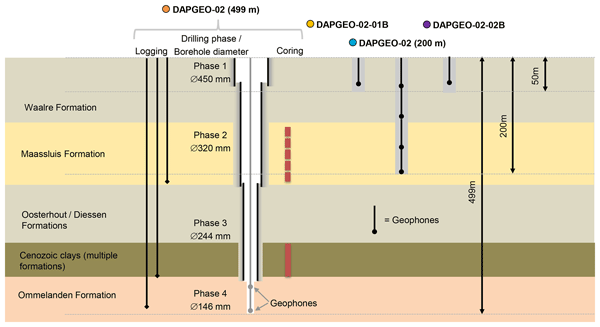
Philip J. Vardon, Hemmo A. Abels, Auke Barnhoorn, Stijn Beernink, David Bruhn, Jens van den Berg, Alexandros Daniilidis, Anne-Catherine Dieudonné, Guy Drijkoningen, Pieter Geris, Ties de Jong, Pauline Kruiver, Susanne Laumann, Dirk Munsterman, Erika Neeft, Pieter Pauw, Tobias Schmiedel, Evert Slob, Liliana Vargas Meleza, Denis Voskov, and Kees Wapenaar
Sci. Dril., 35, 211–227, https://doi.org/10.5194/sd-35-211-2026, https://doi.org/10.5194/sd-35-211-2026, 2026
Short summary
Short summary
As part of a geothermal project in Delft, the Netherlands, a 500 m deep multifunctional research borehole and monitoring station (called DAPGEO-02) was drilled in spring 2022. Cores and other solid samples were taken using a comprehensive logging programme using tools lowered into the borehole, and sensitive instruments were installed to measure any minor seismicity. The data from this borehole are publicly available, and physical sample requests can be made to promote scientific discovery.
Philip J. Vardon, Hemmo A. Abels, Auke Barnhoorn, Stijn Beernink, David Bruhn, Jens van den Berg, Alexandros Daniilidis, Anne-Catherine Dieudonné, Guy Drijkoningen, Pieter Geris, Ties de Jong, Pauline Kruiver, Susanne Laumann, Dirk Munsterman, Erika Neeft, Pieter Pauw, Tobias Schmiedel, Evert Slob, Liliana Vargas Meleza, Denis Voskov, and Kees Wapenaar
Sci. Dril., 35, 211–227, https://doi.org/10.5194/sd-35-211-2026, https://doi.org/10.5194/sd-35-211-2026, 2026
Short summary
Short summary
As part of a geothermal project in Delft, the Netherlands, a 500 m deep multifunctional research borehole and monitoring station (called DAPGEO-02) was drilled in spring 2022. Cores and other solid samples were taken using a comprehensive logging programme using tools lowered into the borehole, and sensitive instruments were installed to measure any minor seismicity. The data from this borehole are publicly available, and physical sample requests can be made to promote scientific discovery.
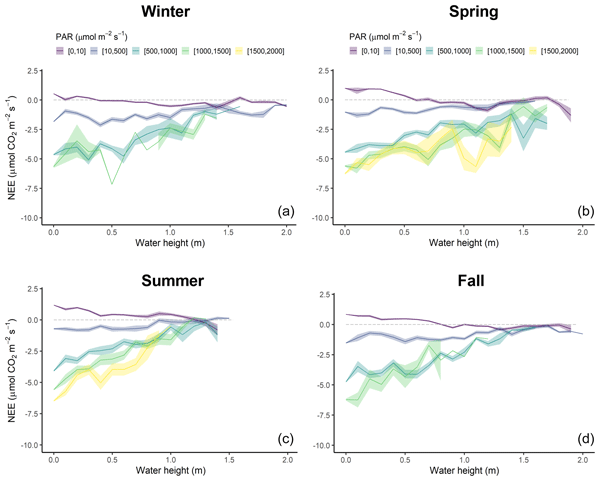
Jérémy Mayen, Pierre Polsenaere, Éric Lamaud, Marie Arnaud, Pierre Kostyrka, Jean-Marc Bonnefond, Philippe Geairon, Julien Gernigon, Romain Chassagne, Thomas Lacoue-Labarthe, Aurore Regaudie de Gioux, and Philippe Souchu
Biogeosciences, 21, 993–1016, https://doi.org/10.5194/bg-21-993-2024, https://doi.org/10.5194/bg-21-993-2024, 2024
Short summary
Short summary
We deployed an atmospheric eddy covariance system to measure continuously the net ecosystem CO2 exchanges (NEE) over a salt marsh and determine the major biophysical drivers. Our results showed an annual carbon sink mainly due to photosynthesis of the marsh plants. Our study also provides relevant information on NEE fluxes during marsh immersion by decreasing daytime CO2 uptake and night-time CO2 emissions at the daily scale, whereas the immersion did not affect the annual marsh C balance.

Mohammadkarim Karimpour, Evert Slob, and Laura Valentina Socco
Solid Earth, 13, 1569–1583, https://doi.org/10.5194/se-13-1569-2022, https://doi.org/10.5194/se-13-1569-2022, 2022
Short summary
Short summary
Near-surface characterisation is of great importance. Surface wave tomography (SWT) is a powerful tool to model the subsurface. In this work we compare straight-ray and curved-ray SWT at near-surface scale. We apply both approaches to four datasets and compare the results in terms of the quality of the final model and the computational cost. We show that in the case of high data coverage, straight-ray SWT can produce similar results to curved-ray SWT but with less computational cost.
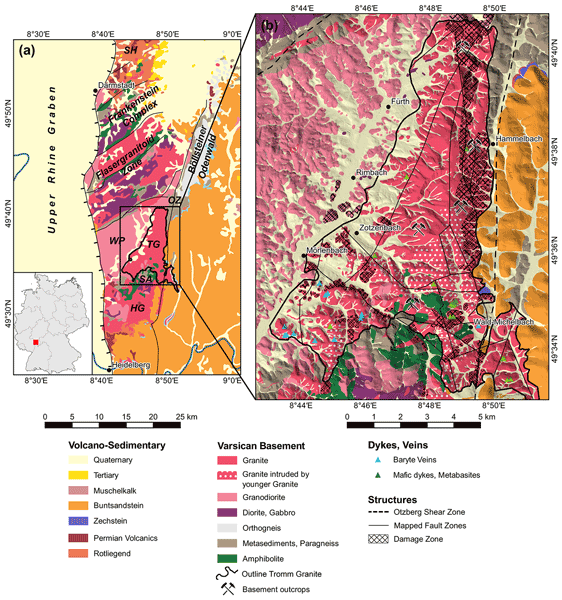
Matthis Frey, Claire Bossennec, Lukas Seib, Kristian Bär, Eva Schill, and Ingo Sass
Solid Earth, 13, 935–955, https://doi.org/10.5194/se-13-935-2022, https://doi.org/10.5194/se-13-935-2022, 2022
Short summary
Short summary
The crystalline basement is considered a ubiquitous and almost inexhaustible source of geothermal energy in the Upper Rhine Graben. Interdisciplinary investigations of relevant reservoir properties were carried out on analogous rocks in the Odenwald. The highest hydraulic conductivities are expected near large-scale fault zones. In addition, the combination of structural geological and geophysical methods allows a refined mapping of potentially permeable zones.
Cited articles
Baars, T. F., Huis in `t Veld, R., Zhang, L., Koopmans, M., McLean, D., Martinius, A. W., and Abels, H. A.: A cyclostratigraphic framework of the upper Carboniferous Westoe and Cleaver formations in the southern North Sea Basin as a methodology for stratigraphic reservoir characterisation, Netherlands Journal of Geosciences, 102, https://doi.org/10.1017/njg.2023.8, 2023.
Bloemendal, M., Vardon, P. J., Pijnenborg, M., Sudintas, G., Medema, A., Marif, K., Beernink, S., van Veldhuizen, F., Snelleman, S., and van Oort, T.: A techno-economic evaluation of high temperature thermal aquifer storage (HT-ATES) for use with the geothermal well on the TU Delft campus, World Geothermal Congress, https://worldgeothermal.org/pdf/IGAstandard/WGC/2020/16013.pdf (last access: 9 February 2026), 2021.
Boersma, Q. D., Bruna, P. O., de Hoop, S., Vinci, F., Tehrani, A. M., and Bertotti, G.: The impact of natural fractures on heat extraction from tight Triassic sandstones in the West Netherlands Basin: a case study combining well, seismic and numerical data, Netherlands Journal of Geosciences, 100, https://doi.org/10.1017/njg.2020.21, 2021.
Chen, Y., Rongier, G., Mullins, J. R., Voskov, D., and Daniilidis, A.: Coupled Numerical and Analytical Simulation on Delft Campus Geothermal Well, 50th Stanford Workshop on Geothermal Reservoir Engineering, https://pangea.stanford.edu/ERE/db/GeoConf/papers/SGW/2025/Chen1.pdf (last access: 10 February, 2026), 2025.
Den Hartog Jager, D. G.: Fluviomarine sequences in the Lower Cretaceous of the West Netherlands Basin: correlation and seismic expression, in: Geology of gas and oil under the Netherlands: Dordrecht, edited by: Rondeel, H. E., Batjes, D. A. J., and Nieuwenhuijs, W. H., Kluwer Academic Publishers, 229–241 pp., https://doi.org/10.1007/978-94-009-0121-6_19, 1996.
Drijkoningen, G., Ravilov, M., Heller, K., and Van Beek, K.: Capacitively coupled EM sensors integrated in non-corrosive casings for long-term CSEM monitoring, 85th EAGE Annual Conference & Exhibition, edited by: Rondeel, H. E., https://doi.org/10.3997/2214-4609.2024101491, 2024.
Eltayieb, M., Werthmüller, D., Drijkoningen, G., and Slob, E.: Feasibility Study of Controlled-Source Electromagnetic Method for Monitoring Low-Enthalpy Geothermal Reservoirs, Applied Sciences, 13, 9399, H. E. Rondeel 2023.
ETIP-G: European Technology and Innovation Platform on Geothermal “Strategic research and innovation agenda”, 116 pp., ISBN 978-2-9601946-3-0, 2023.
Geluk, M. C. and Röhling H.-G.: High-resolution sequence stratigraphy of the Lower Triassic `Buntsandstein' in the Netherlands and northwestern Germany, Geol Mijnbouw, 76, 227–246, 1997.
Hakanson, E., Bromley, V., and Perch-Nielsen, K.: Maastrichtian Chalk of North-West Europe – a Pelagic Shelf Sediment, Chapter 9 in Pelagic Sediments: On land and under the Sea, edited by: Hsü, K. J. and Jenkyns, H. C., https://doi.org/10.1002/9781444304855.ch9, 1975.
IEA: The Future of Geothermal Energy, IEA Publications – International Energy Agency, 126 pp., https://www.iea.org/reports/the-future-of-geothermal-energy (last access: 10 February 2026), 2024.
Limberger, J., Boxem, T., Pluymaekers, M., Bruhn, D., Manzella, A., Calcagno, P., Beekman, F., Cloetingh, S., and van Wees, J.-D.: Geothermal energy in deep aquifers: A global assessment of the resource base for direct heat utilization, Renewable and Sustainable Energy Reviews, 82, 961–975, ISSN 1364-0321, https://doi.org/10.1016/j.rser.2017.09.084, 2018.
Maniar, Z.: Reservoir quality analysis of the Triassic sandstones in the Nederweert and Naaldwijk areas: a post-mortem study, Delft University of Technology, https://repository.tudelft.nl/islandora/object/uuid:f2f2427b-a056-4b5e-b9d7-76b076950955 (last access: 10 February 2026), 2019.
McInerney, F. A. and Wing, S. L.: The PETM: A perturbation of carbon cycle, climate, and biosphere with implications for the future, Ann. Rev. of Earth Plan. Sci., 39, 489–516, 2011.
Mijnlieff, H. F.: Introduction to the geothermal play and reservoir geology of the Netherlands, Netherlands Journal of Geosciences, 99, https://doi.org/10.1017/njg.2020.2, 2020.
Oudshoorn, C., Werthmüller, D., Slob, E., and Voskov, D.: Numerical experiment on data assimilation for geothermal doublets using production data and electromagnetic observations, Geophysics, 89, M227–M237, https://doi.org/10.1190/GEO2023-0463.1, 2024.
Song, G., Geiger, S., Voskov, D., Abels, H. A., and Vardon P. J.: Assessing the Ensemble Smoother with Multiple Data Assimilation for Subsurface Fluvial Geothermal Systems, 50th Stanford Workshop on Geothermal Reservoir Engineering, https://doi.org/10.22541/essoar.174835517.79259134/v1, 2025.
Vardon, P. J., Bruhn, D. F., Steiginga, A., Cox, B., Abels, H., Barnhoorn, A., Drijkoningen, G., Slob, E., and Wapenaar, K.: A Geothermal Well Doublet for Research and Heat Supply of the TU Delft Campus, World Geothermal Congress, https://arxiv.org/abs/2003.11826 (last access: 10 February 2025), 2020.
Vardon, P. J., Abels, H., Barnhoorn, A., Daniilidis, A., Bruhn, D., Drijkoningen, G., Elliott, K., van Esser, B., Laumann, S., van Paassen, P., Vargas Meleza, L., Vondrak, A., and Voskov, D.: A research and energy production geothermal project on the TU Delft campus: Project implementation and initial data collection, Proceedings of the 49th Stanford Workshop on Geothermal Reservoir Engineering, https://pangea.stanford.edu/ERE/db/GeoConf/papers/SGW/2024/Vardon.pdf (last access: 10 February 2026), 2024a.
Vardon, P. J., Abels, H., Barnhoorn, A., Daniilidis, A., Drijkoningen, G., Laumann, S., Vargas Meleza, L., and Voskov, D.: Geothermal Project on TU Delft Campus Collection, Version 6, 4TU.ResearchData. collection, https://doi.org/10.4121/85b3725b-80fa-4b0b-9db2-475bfd8f0265.v6, 2024b.
Vardon, P. J., Laumann, S. J., van Esser, B. T. M., Ursem, L. J. H., van Schravendijk, B., Vargas Meleza, L., Barnhoorn, A., Abels, H. A., Vondrak, A. G., Drijkoningen, G. G., van Paassen, P. A. M., Elliott, K. N., van den Berg, J. J., and Friebel, M.: End-of-Well Science Programme Report DEL-GT-01 and DEL-GT-02, TU Delft campus geothermal project, Delft University of Technology, https://resolver.tudelft.nl/uuid:6ce07471-6986-434e-aa24-ad6e1f6714d9 (last access: 10 February 2026), 2024c.
Voskov, D., Abels, H., Barnhoorn, A., Chen, Y., Daniilidis, A., Bruhn, D., Drijkoningen, G., Geiger, S. Laumann, S., Song, G., Vardon, P., Vargas Meleza, L., Verschuur, E., and Vondrak, A.: A research and production geothermal project on the TU Delft campus: initial modeling and establishment of a digital twin, 49th Stanford Workshop on Geothermal Reservoir Engineering, https://pangea.stanford.edu/ERE/db/GeoConf/papers/SGW/2024/Voskov.pdf (last access: 10 February 2026), 2024.
Short summary
A workshop on the the scientific value and use of a 4500 m deep borehole on the campus of TU Delft in the Netherlands was held in June 2024. The borehole will serve as an observation infrastructure for processes in the underground related to human activities, such as exploitation of energy resources like geothermal energy or storage of heat or gas. The location is of great interest for this purpose as there are already two deep geothermal wells and shallow wells for heat storage.
A workshop on the the scientific value and use of a 4500 m deep borehole on the campus of TU...


