

Articles | Volume 35, issue 2
https://doi.org/10.5194/sd-35-171-2026
© Author(s) 2026. This work is distributed under
the Creative Commons Attribution 4.0 License.
the Creative Commons Attribution 4.0 License.
https://doi.org/10.5194/sd-35-171-2026
© Author(s) 2026. This work is distributed under
the Creative Commons Attribution 4.0 License.
the Creative Commons Attribution 4.0 License.
Science report
| 
21 Sep 2026
Science report |
| 21 Sep 2026
| 21 Sep 2026
GRIND-ECT: geological research through integrated Neoproterozoic drilling – Ediacaran–Cambrian transition
Catherine V. Rose
CORRESPONDING AUTHOR

School of Earth and Environmental Sciences, University of St Andrews, St Andrews, KY16 9TS, Scotland, UK
Simone A. Kasemann
Universität Bremen, MARUM I, 28359 Bremen, Germany
Francis A. Macdonald
Department of Earth Sciences, University of California-Santa Barbara, Santa Barbara, CA 93106, USA
Melanie Mesli
School of Earth and Environmental Sciences, University of St Andrews, St Andrews, KY16 9TS, Scotland, UK
Andreas Nduutepo
Regional Geoscience Division, Geological Survey of Namibia, Windhoek, Namibia
Ricardo Trindade
Instituto de Astronomia, Geofisica e Ciencias Atmosfericas, Universidade de São Paulo, São Paulo, Brazil
Maoyan Zhu
Nanjing Institute of Geology and Paleontology, Nanjing 210008, China
Anthony R. Prave
School of Earth and Environmental Sciences, University of St Andrews, St Andrews, KY16 9TS, Scotland, UK
Related authors
No articles found.
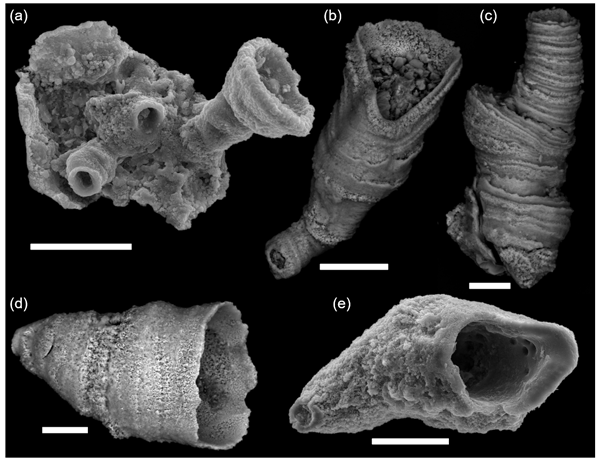
Thiago F. Toniolo, Juliana M. Leme, Dermeval A. Carmo, Thomas R. Fairchild, Luana Morais, and Ricardo I. F. Trindade
J. Micropalaeontol., 42, 83–93, https://doi.org/10.5194/jm-42-83-2023, https://doi.org/10.5194/jm-42-83-2023, 2023
Short summary
Short summary
The early fossils of animals with an exoskeleton witness a key episode in the evolution of life. These fossils, such as the cloudinids, have tubular shapes and an uncertain affinity. The reaction between H2O2 and pyrite can lead to the generation of objects very similar to these fossils. For this reason, the method of rock preparation is a cause for concern. Besides discussing methodology, this work provides criteria to distinguish artifacts from fossils based on their composition and structure.
Cited articles
Adôrno, R. R., do Carmo, D. A., Germs, G., Walde, D. H. G., Denezine, M., Boggiani, P. C., Sousa e Silva, S. C., Vasconcelos, J. R., Tobias, T. C., Guimarães, E. M., Vieira, L. C., Figueiredo, M. F., Moraes, R., Caminha, S. A., Suarez, P. A. Z., Rodrigues, C. V., Caixeta, G. M., Pinho, D., Schneider, G., and Muyamba, R.: Cloudina lucianoi (Beurlen & Sommer, 1957), Tamengo Formation, Ediacaran, Brazil: Taxonomy, analysis of stratigraphic distribution and biostratigraphy, Precambrian Res., 301, 19–35, https://doi.org/10.1016/j.precamres.2017.08.023, 2017.
Afonso, J. W. L., Pereira, L. G., de Faria, B. A., Romero, G. R., Amorim, K. B., Basso, J. M. L., and Trindade, R. I. F.: Stratigraphical and sedimentological controls on the distribution of Cloudina bioclastic accumulations in the terminal Ediacaran Tamengo Formation (Corumbá Group), Brazil, Sediment. Geol., 463, 106580, https://doi.org/10.1016/j.sedgeo.2024.106580, 2024.
Almeida, F. F. M.: Geologia da Serra da Bodoquena (Mato Grosso), DNPM, Departamento Nacional da Produção Mineral, 1965.
Amorim, K. B., Afonso, J. W. L., Leme, J. de M., Diniz, C. Q. C., Rivera, L. C. M., Gómez-Gutiérrez, J. C., Boggiani, P. C., and Trindade, R. I. F.: Sedimentary facies, fossil distribution and depositional setting of the late Ediacaran Tamengo Formation (Brazil), Sedimentology, 67, 3422–3450, https://doi.org/10.1111/sed.12967, 2020.
Babinski, M., Boggiani, P. C., Fanning, C. M., Fairchild, T. R., Simon, C. M., and Sial, A. N.: U–Pb SHRIMP geochronology and isotope chemostratigraphy (C, O, Sr) of the Tamengo Formation, southern Paraguay Belt, Brazil, in: VI South American Symposium on Isotope Geology, Book of Abstracts, INGEIS – Instituto de Geocronología y Geología Isotópica, p. 160, https://repositorio.usp.br/item/001701908 (last access: 20 August 2026), 2008.
Becker-Kerber, B., Pacheco, M. L. A. F., Rudnitzki, I. D., Galante, D., Rodrigues, F., and Leme, J. D. M.: Ecological interactions in Cloudina from the Ediacaran of Brazil: implications for the rise of animal biomineralization, Sci. Rep., 7, 5482, https://doi.org/10.1038/s41598-017-05753-8, 2017.
Boggiani, P. C.: Análise Estratigráfica da Bacia Corumbá (Neoproterozóico) – Mato Grosso do Sul, PhD Thesis, Universidade de São Paulo, São Paulo, https://doi.org/10.11606/T.44.1998.tde-14082013-111741, 1998.
Boggiani, P. C., Gaucher, C., Sial, A. N., Fairchild, T. R., Babinski, M., Simon, C. M., and Ferreira, V. P.: Chemostratigraphy of the Tamengo Formation (Corumbá Group, Brazil): calibration of the Ediacaran C-isotope curve, Precamb. Res., 182, 382–401, https://doi.org/10.1016/j.precamres.2010.06.003, 2010.
Bowring, S. A., Grotzinger, J. P., Condon, D. J., Ramezani, J., Newall, M. J., and Allen, P. A.: Geochronologic constraints on the chronostratigraphic framework of the Neoproterozoic Huqf Supergroup, Sultanate of Oman, Am. J. Sci., 307, 1097–1145, 2007.
Bowyer, F. T., Zhuravlev, A. Y., Wood, R., Shields, G. A., Zhou, Y., Curtis, A., Poulton, S. W., Condon, D. J., Yang, C., and Zhu, M.: Calibrating the temporal and spatial dynamics of the Ediacaran–Cambrian radiation of animals, Earth-Sci. Rev., 225, 103913, https://doi.org/10.1016/j.earscirev.2021.103913, 2022.
Bowyer, F. T., Messori, F., Wood, R., Linnemann, U., Rojo-Pérez, E., Zieger-Hofmann, M., Zieger, J., Ndeunyema, J., Shipanga, M., Mataboge, B., Condon, D., Rose, C. V., Uahengo, C.-I., Gaynor, S. P., Müller, I. A., Geyer, G., Vennemann, T., Davies, J. H. F. L., and Ovtcharova, M.: Foundational uncertainties in terminal Ediacaran chronostratigraphy revealed by high-precision zircon U–Pb geochronology of the Nama Group, Namibia, Earth-Sci. Rev., 268, 105169, https://doi.org/10.1016/j.earscirev.2025.105169, 2025.
Brasier, M. D., Prave, A. R., Van Wiemeersch, B., and Compston, W.: Integrated chemo- and biostratigraphic calibration of early animal evolution: Neoproterozoic–early Cambrian of southwest Mongolia, Geol. Mag., 133, 445–485, https://doi.org/10.1017/S0016756800007603, 1996.
Brocks, J., Jarrett, A., Sirantoine, E., Hallmann, C., Hoshino, Y., and Liyanage, T.: The rise of algae in Cryogenian oceans and the emergence of animals, Nature, 548, 578–581, https://doi.org/10.1038/nature23457, 2017.
Campanha, G. A. da C., Boggiani, P. C., Sallun Filho, W., Sá, F. R. de, Zuquim, M. de P. S., and Piacentini, T.: A faixa de dobramento Paraguai na Serra da Bodoquena e depressão do Rio Miranda, Mato Grosso do Sul, Geologia USP. Série Científica, 11, 79–96, https://doi.org/10.5327/Z1519-874X2011000300005, 2011.
Cole, D. B., Mills, D. B., Erwin, D. H., Sperling, E. A., Porter, S. M., Reinhard, C. T., and Planavsky, N. J.: Co-evolution of surface oxygen levels and animals, Geobiol., 18, 260–281, https://doi.org/10.1111/gbi.12382, 2020.
Condon, D. J., Boggiani, P., Fike, D., Halverson, G. P., Kasemann, S., Knoll, A. H., Macdonald, F. A., Prave, A. R., and Zhu, M.: Accelerating Neoproterozoic research through scientific drilling, Sci. Dril., 19, 17–25, https://doi.org/10.5194/sd-19-17-2015, 2015.
Darroch, S. A. F., Casey, M. M., Antell, G. T., Sweeney, A., and Saupe, E. E.: High preservation potential of paleogeographic range size distributions in deep time, Am. Nat., 196, 454–471, https://doi.org/10.1086/710176, 2020.
Darroch, S. A. F., Boag, T. H., Racicot, R. A., Tweedt, S. M., Mason, S. J., Erwin, D. H., and Laflamme, M.: A mixed Ediacaran–metazoan assemblage from the Zaris Sub-basin, Namibia, Palaeogeogr. Palaeoclimatol. Palaeoecol., 459, 198–208, https://doi.org/10.1016/j.palaeo.2016.06.020, 2016.
Darroch, S. A. F., Smith, E. F., Laflamme, M., and Erwin, D. H.: Ediacaran extinction and Cambrian Explosion, Trends Ecol. Evol., 33, 653–663, https://doi.org/10.1016/j.tree.2018.06.003, 2018.
Darroch, S. A. F., Cribb, A. T., Buatois, L. A., Germs, G. J. B., Kenchington, C. G., Smith, E. F., Mocke, H., O'Neil, G. R., Schiffbauer, J. D., Maloney, K. M., Racicot, R. A., Turk, K. A., Gibson, B. M., Almond, J., Koester, B., Boag, T. H., Tweedt, S. M., and Laflamme, M.: The trace fossil record of the Nama Group, Namibia: Exploring the terminal Ediacaran roots of the Cambrian explosion, Earth-Sci. Rev., 212, 103435, https://doi.org/10.1016/j.earscirev.2020.103435, 2021.
Darroch, S. A. F., Mocke, H., Gibson, B. M., Tingle, K. E., Schiffbauer, J. D., Nelson, L. L., and Laflamme, M.: Lagerstätten: Ediacaran soft-bodied fossils from the Nama Group, J. Geol. Soc., 183, jgs2024-288, https://doi.org/10.1144/jgs2024-288, 2025.
Diniz, C. Q. C., Leme, J. de M., and Boggiani, P. C.: New species of macroalgae from the Tamengo Formation, Ediacaran, Brazil, Front. Earth Sci., 9, 1–11, https://doi.org/10.3389/feart.2021.748876, 2021.
Elliott, D. A., Trusler, P. W., Narbonne, G. M., Vickers-Rich, P., Morton, N., Hall, M., Hoffmann, K. H. and Schneider, G. I. C.: Ernietta from the late Ediacaran Nama Group, Namibia, J. Paleontol., 90, 1017–1026, 2016.
Erwin, D. H.: Early metazoan life: divergence, environment and ecology, Phil. Trans. R. Soc. B, 370, 20150036, https://doi.org/10.1098/rstb.2015.0036, 2015.
Erwin, D. H., Laflamme, M., Tweedt, S. M., Sperling, E. A., Pisani, D., and Peterson, K. J.: The Cambrian conundrum: early divergence and later ecological success in the early history of animals, Science, 334, 1091–1097, https://doi.org/10.1126/science.1206375, 2011.
Fan, H., Wen, H., Han, T., Zhu, X., Feng, L., and Chang, H.: Oceanic redox condition during the late Ediacaran (551–541 Ma), South China, Geochim. Cosmochim. Acta, 238, 343–356, https://doi.org/10.1016/j.gca.2018.06.037, 2018.
Fazio, G., Guimarães, E. M., Walde, D. W. G., do Carmo, D. A., Adôrno, R. R., Vieira, L. C., Denezine, M., Silva, C. B. da, Godoy, H. V. de, Borges, P. C., and Pinho, D.: Mineralogical and chemical composition of Ediacaran-Cambrian pelitic rocks of the Tamengo and Guaicurus formations (Corumbá Group, MS, Brazil): Stratigraphic positioning and paleoenvironmental interpretations, J. South Am. Earth Sci., 90, 487–503, https://doi.org/10.1016/j.jsames.2019.01.009, 2019.
Fernandes, H. A., Boggiani, P. C., Afonso, J. W. L., Amorim, K. B., and Trindade, R. I. F.: Sedimentary and tectonic breccias at the base of the Ediacaran Tamengo Formation (Corumbá Group): a comparative study, Braz. J. Geol., 52, 1–15, https://doi.org/10.1590/2317-4889202220210062, 2022.
Fernandes, H. A., Paula-Santos, G., Pereira, L. G., Rimi, L. T., Pescarini, T., Elias, E., Bedoya-Rueda, C., Cardoso Lucas, V., Rodrigues, L., Mazzamuto, K., Stama, L., Caetano-Filho, S., Babinski, M., Boggiani, P. C., Leme, J. M., Bowyer, F., Rose, C. V., and Trindade, R. I. F.: Coevolution of life and environment during the Ediacaran–Cambrian transition: Clues from litho-, bio-, and chemostratigraphy of the Corumbá Group, Brazil, Precamb. Res., 427, 107887, https://doi.org/10.1016/j.precamres.2025.107887, 2025.
Freitas, B. T., Warren, L. V., Boggiani, P. C., De Almeida, R. P., and Piacentini, T.: Tectono-sedimentary evolution of the Neoproterozoic BIF-bearing Jacadigo Group, SW-Brazil, Sediment. Geol., 238, 48–70, https://doi.org/10.1016/j.sedgeo.2011.04.001, 2011.
Freitas, N. C., Almeida, J., Heilbron, M., Cutts, K., and Dussin, I.: The Cabo Frio Thrust: A folded suture zone, Ribeira belt, SE Brazil, J. Struct. Geol., 149, 104379, https://doi.org/10.1016/j.jsg.2021.104379, 2021.
Gaucher, C., Boggiani, P. C., Sprechmann, P., Sial, A. N., and Fairchild, T.: Integrated correlation of the Vendian to Cambrian Arroyo del Soldado and Corumbá Groups (Uruguay and Brazil): palaeogeographic, palaeoclimatic and palaeobiologic implications, Precamb. Res., 120, 241–278, https://doi.org/10.1016/S0301-9268(02)00140-7, 2003.
Germs, G. J. B.: Trace fossils from the Nama Group, South West Africa, J. Paleontol., 46, 864–870, 1972.
Germs, G. J. B.: Implications of a sedimentary facies and depositional environmental analysis of the Nama Group in South West Africa/Namibia, Spec. Publ. Geol. Soc. S. Afr., 11, 89–114, 1983.
Godoy, A. M., Pinho, F. E. C., Manzano, J. C., Araújo, L. M. B., Silva, J. A., and Figueiredo, M.: Estudos isotópicos das rochas granitóides neoproterozóicas da Faixa de Dobramento Paraguai, Rev. Bras. Geociênc., 40, 380–391, 2010.
Gong, Z., Baillie, I., Nelson, L. L., Gerasimov, S. H., Rose, C. V., and Smith, E. F.: Magnetic susceptibility cyclostratigraphy of the lower Schwarzrand Subgroup in southern Namibia refines temporal calibration of late Ediacaran bilaterian radiation, Glob. Planet. Change, 245, 104668, https://doi.org/10.1016/j.gloplacha.2024.104668, 2025.
Grotzinger, J. P. and Miller, R. M.: The Nama Group, in: The Geology of Namibia Volume 2: Neoproterozoic and Early Palaeozoic Rocks of the Damara Orogen, Min. Mines & Energy Geol. Surv., 13, 229–272, ISBN 978-0-86976-732-0, 2008.
Grotzinger, J. P., Bowring, S. A., Saylor, B. Z., Kaufman, A. J., Knoll, A. H., and Martin, M. W.: Biostratigraphic and geochronologic constraints on early animal evolution, Science, 270, 598–604, https://doi.org/10.1126/science.270.5236.598, 1995.
Gray, D. R., Oliver, G. J. H., Evans, D. A. D., Kley, J., and Turner, S.: A Damara orogen perspective on the assembly of southwestern Gondwana, in West Gondwana: Pre-Cenozoic Correlations Across the South Atlantic Region, Geol. Soc. London Spec. Publ., 294, 257–278, 2008.
Hall, M., Kaufman. A. J., Vickers-Rich, P., Ivantsov, A., Trusler, P., Linnemann, U., Hofmann, M., Elliott, D., Cui, H., Fedonkin, M., Hoffmann, K.-H., Wilson, S., Schneider, G., and Smith, J. : Stratigraphy, palaeontology and geochemistry of the late Neoproterozoic Aar Member, Namibia: reflecting environmental controls on Ediacara fossil preservation during the terminal Proterozoic in Africa Gondwana, Precamb. Res., 238, 214–232, https://doi.org/10.1016/j.precamres.2013.09.009, 2013.
Halverson, G. P., Maloof, A. C., Katz, M. E., Milliken, R. E., Evans, D. A. D., Kirschvink, J. L., and Reinhard, C.: Neoproterozoic chemostratigraphy, Precamb. Res., 182, 337–350, https://doi.org/10.1016/j.precamres.2010.03.002, 2010.
Hiatt, E. E., Pufahl, P. K., and Guimarães da Silva, L.: Iron and phosphorus biochemical systems and the Cryogenian–Ediacaran transition, Jacadigo basin, Brazil: Implications for the Neoproterozoic oxygenation event, Precamb. Res., 337, 105533, https://doi.org/10.1016/j.precamres.2019.105533, 2020.
Hippertt, J. P. T. M., Rudnitzki, I. D., Morais, L., Freitas, B., Romero, G. R., Fernandes, H. A., Leite, M. G. P., Leme, J. M., Boggiani, P., and Trindade, R. I. F.: Sedimentary evolution and sequence stratigraphy of Ediacaran high-grade phosphorite–dolomite–shale successions of the Bocaina Formation (Corumbá Group), Central Brazil: Implications for the Neoproterozoic phosphogenic event, Sedimentology, 70, 2371, https://doi.org/10.1111/sed.13125, 2023.
Hoffman, P. F., Abbot, D. S., Ashkenazy, Y., Benn, D. I., Brocks, J. J., Cohen, P. A., Cox, G. M., Creveling, J. R., Donnadieu, Y., Erwin, D. H., Fairchild, I. J., Ferreira, D., Goodman, J. C., Halverson, G. P., Jansen, M. F., Le Hir, G., Love, G. D., Macdonald, F. A., Maloof, A. C., Partin, C. A., Ramstein, G., Rose, B. E. J., Rose, C. V., Sadler, P. M., Tziperman, E., Voigt, A., and Warren, S. G.: Snowball Earth climate dynamics and Cryogenian geology–geobiology, Sci. Adv., 3, e1600983, https://doi.org/10.1126/sciadv.1600983, 2017.
Jensen, S., Saylor, B. Z., Gehling, J. G., and Germs, G. J. B.: Complex trace fossils from the terminal Proterozoic of Namibia, Geology, 28, 143–146, https://doi.org/10.1130/0091-7613(2000)28<143:CTFFTT>2.0.CO;2, 2000.
Li, Z.-X., Bogdanova, S. V., Collins, A. S., Davidson, A., de Waele, B., Ernst, R. E., Fitzsimons, I. C. W., Fuck, R. A., Gladkochub, D. P., Jacobs, J., Karlstrom, K. E., Lu, S., Nelson, D. R., Njasm, I., Pease, V., Pisarevsky, S., Thrane, K., Vernikovsky, V., Whitehouse, M. J., and Zhao, G.: Assembly, configuration, and break-up history of Rodinia: a synthesis, Precamb. Res., 160, 179–210, https://doi.org/10.1016/j.precamres.2007.04.021, 2008.
Linnemann, U., Hinz, K., Bussert, R., Mortensen, J., Naafs, B., Peucker-Ehrenbrink, B., and Wandel, A.: New high-resolution age data from the Ediacaran–Cambrian boundary indicate rapid, ecologically driven onset of the Cambrian explosion, Terra Nova, 31, 49–58, https://doi.org/10.1111/ter.12368, 2019.
Love, G. D., Grosjean, E., Stalvies, C., Fike, D. A., Grotzinger, J. P., Bradley, A. S., Kelly, A. E., Bhatia, M., Meredith, W., Snape, C. E., Bowring, S. A., Condon, D. J., and Summons, R. E.: Fossil steroids record the appearance of Demospongiae during the Cryogenian period, Nature, 457, 718–21, https://doi.org/10.1038/nature07673, 2009.
Manzano, J. C., Godoy, A. M., and de Araújo, L. M. B.: Contexto tectônico dos granitóides neoproterozóicos da faixa de dobramentos Paraguai, MS e MT, Geociencias, 27, 493–507, 2008.
Misi, A., Kaufman, A. J., Veizer, J., Powis, K., Azmy, K., Boggiani, P. C., Gaucher, C., Teixeira, J. B. G., Sanches, A. L., and Iyer, S. S. S.: Chemostratigraphic correlation of Neoproterozoic successions in South America, Chem. Geol., 237, 143–167, https://doi.org/10.1016/j.chemgeo.2007.08.010, 2007.
Morais, L., Fairchild, T. R., Freitas, B. T., Rudnitzki, I. D., Silva, E. P., Lahr, D., Moreira, A. C., Abrahão Filho, E. A., Leme, J. M., and Trindade, R. I. F.: Doushantuo–Pertatataka–like acritarchs from the late Ediacaran Bocaina Formation (Corumbá Group, Brazil), Front. Earth Sci., 9, 787011, https://doi.org/10.3389/feart.2021.787011, 2021.
Morais, L., Freitas, B. T., Fairchild, T. R., Clavijo-Arcos, R. E., Guillong, M., Vance, D., Campos, M. D. R., Babinski, M., Pereira, L. G., Leme, J. M., Boggiani, P. C., Osés, G., Rudnitzki, I. D., Galante, D., Rodrigues, F., and Trindade, R. I. F.: Dawn of diverse shelled and carbonaceous animal microfossils at ∼ 571 Ma, Sci. Rep., 14, 14916, https://doi.org/10.1038/s41598-024-65671-4, 2024.
Narbonne, G. M., Saylor, B. Z., and Grotzinger, J. P.: The youngest Ediacaran fossils from Southern Africa, J. Paleontol., 71, 953–967, https://doi.org/10.1017/S0022336000035940, 1997.
Nelson, L. L., Ramezani, J., Almond, J. E., Darroch, S. A. F., Taylor, W. L., Brenner, D. C., Furey, R. P., Turner, M., and Smith, E. F.: Pushing the boundary: A calibrated Ediacaran–Cambrian stratigraphic record from the Nama Group in northwestern Republic of South Africa, Earth Planet. Sci. Lett., 580, 117396, https://doi.org/10.1016/j.epsl.2022.117396, 2022.
Nelson, L. L., Smith, E. F., Darroch, S. A. F., Baillie, I., Ramezani, J., Almond, J. E., Swart, R., Polomski, D. E., and Turk, K. A.: A basin in transition: ecological, environmental, and tectonic shifts across the Ediacaran–Cambrian boundary in the Nama Group, Kalahari Craton, Am. J. Sci., 326, https://doi.org/10.2475/001c.151699, 2026.
Oliveira, R. S. de, Nogueira, A. C. R., Romero, G. R., Truckenbrodt, W., and da Silva Bandeira, J. C.: Ediacaran ramp depositional model of the Tamengo Formation, Brazil, J. South Am. Earth Sci., 96, 102348, https://doi.org/10.1016/j.jsames.2019.102348, 2019.
Pacheco, M. L. A. F., Galante, D., Rodrigues, F., Leme, J. de M., Bidola, P., Hagadorn, W., Stockmar, M., Herzen, J., Rudnitzki, I.D., Pfeiffer, F., and Marques, A. C.: Insights into the skeletonization, lifestyle, and affinity of the unusual Ediacaran fossil Corumbella, PLoS ONE, 10, e0114219, https://doi.org/10.1371/journal.pone.0114219, 2015.
Parry, L. A., Boggiani, P. C., Condon, D. J., Garwood, R. J., Leme, J. D. M., McIlroy, D., Brasier, M. D., Trindade, R., Campanha, G. A. C., Pacheco, M. L. A. F., Diniz, C. Q. C., and Liu, A. G.: Ichnological evidence for meiofaunal bilaterians from the terminal Ediacaran and earliest Cambrian of Brazil, Nat. Ecol. Evol., 1, 1455–1464, https://doi.org/10.1038/s41559-017-0295-x, 2017.
Pescarini, T., Trindade, R. I. F., Evans, D. A. D., Kirschvink, J. L., Pierce, J., and Fernandes, H. A.: Magnetic mineralogy and paleomagnetic record of the Nama Group, Namibia: Implications for the large-scale remagnetization of West Gondwanaland and its tectonic evolution, J. Geophys. Res.-Sol. Ea., 130, e2024JB030612, https://doi.org/10.1029/2024JB030612, 2025.
Reinhard, C. T., Planavsky, N. J., Robbins, L. L., Partin, C. A., Gill, B. C., Lalonde, S. V., Bekker, A., Konhauser, K. O., and Lyons, T. W.: Earth's oxygen cycle and the evolution of animal life, P. Natl. Acad. Sci. USA, 113, 8933–8938, https://doi.org/10.1073/pnas.1521544113, 2016.
Romero, G. R., Sanchez, E. A. M., Morais, L., Boggiani, P. C., and Fairchild, T. R.: Tubestone microbialite association in the Ediacaran cap carbonates in the southern Paraguay Fold Belt (SW Brazil): Geobiological and stratigraphic implications for a Marinoan cap carbonate, J. South Am. Earth Sci., 71, 172–181, 2016.
Rose, C., Kunkel, C., Kasemann, S., Macdonald, F., Mesli, M., Nduutepo, A., Trindade, R., Zhu, M., and Prave, A.: ICDP Operational Dataset: Geological Research through Integrated Neoproterozoic Drilling: The Ediacaran-Cambrian Transition (GRIND-ECT), GFZ Helmholtz Centre for Geosciences [data set], https://doi.org/10.5880/ICDP.5064.001, 2026.
Saylor, B. Z., Grotzinger, J. P., and Germs, G. J. B.: Sequence stratigraphy and sedimentology of the Neoproterozoic Kuibis and Schwarzrand Subgroups (Nama Group), southwestern Namibia, Precamb. Res., 73, 153–171, https://doi.org/10.1016/0301-9268(94)00076-4, 1995.
Saylor, B. Z., Grotzinger, J. P., Bowring, S. A., Myrow, P. M., and Kaufman, A. J.: A composite reference section for terminal Proterozoic strata of southern Namibia, J. Sediment. Res., 68, 1223–1235, https://doi.org/10.2110/jsr.68.1223, 1998.
Schreiber, U. M., Richards, D. L., and Becker, T.: Geological map of Namibia: 1 : 250 000 geological series, Sheet 2716, Ai-Ais, Geological Survey of Namibia, 1999.
Spangenberg, J. E., Bagnoud-Velásquez, M., Boggiani, P. C., and Gaucher, C.: Redox variations and bioproductivity in the Ediacaran: Evidence from inorganic and organic geochemistry, Corumbá Group, Brazil, Gond. Res., 26, 1186–1207, https://doi.org/10.1016/j.gr.2013.08.014, 2014.
Trompette, R.: Geology of Western Gondwana (2000–500 Ma): Pan-African/Brasiliano aggregation of South America and Africa, Geology of Western Gondwana (2000–500 Ma): Pan-African–Brasiliano Aggregation of South America and Africa, https://doi.org/10.1201/9781003077664, 1994.
Walde, D. H. G., do Carmo, D. A., Guimarães, E. M., Vieira, L. C., Erdtmann, B.-D., Sanchez, E. A. M., Adôrno, R. R., and Tobias, T. C.: New aspects of Neoproterozoic–Cambrian transition in the Corumbá region (Mato Grosso do Sul, Brazil), Ann. Paléontol., 101, 213–224, https://doi.org/10.1016/j.annpal.2015.07.002, 2015.
Warren, L. V., Pacheco, M. L. A. F., Fairchild, T. R., Simões, M. G., Riccomini, C., Boggiani, P. C., and Cáceres, A. A.: The dawn of animal skeletogenesis: Ultrastructural analysis of the Ediacaran metazoan Corumbella werneri, Geology, 40, 691–694, https://doi.org/10.1130/G33005.1, 2012.
Wood, R., Poulton, S. W., Prave, A. R., Hoffmann, K.-H., Clarkson, M. O., Guilbaud, R., Lyne, J. W., Tostevin, R., Bowyer, F., Penny, A. M., Curtis, A., and Kasemann, S. A.: Dynamic redox conditions control Ediacaran metazoan ecosystems in the Nama Group, Namibia, Precamb. Res., 261, 252–271, https://doi.org/10.1016/j.precamres.2015.02.004, 2015.
Wood, R., Liu, A. G., Bowyer, F., Wilby, P. R., Dunn, F. S., Kenchington, C. G., Hoyal Cuthill, J. F., Mitchell, E. G., and Penny, A.: Integrated records of environmental change and evolution challenge the Cambrian Explosion, Nat. Ecol. Evol., 3, 528–538, https://doi.org/10.1038/s41559-019-0821-6, 2019.
Wood, R. A. and Zhuravlev, A. Y.: Escalation and ecological selectivity of mineralogy in the Cambrian radiation of skeletons, Earth-Sci. Rev., 115, 249–261, https://doi.org/10.1016/j.earscirev.2012.10.002, 2012.
Xiao, S., Droser, M., Gehling, J., Hughes, I. V., Wan, B., Chen, Z., and Yuan, X.: Affirming life aquatic for the Ediacara biota in China and Australia, Geology, 41, 1095–1098, https://doi.org/10.1130/2013304, 2013.
Yang, C., Rooney, A. D., Condon, D. J., Li, X.-H., Grazhdankin, D. V., Bowyer, F. T., Hu, C., Macdonald, F. A., and Zhu, M.: The tempo of Ediacaran evolution, Sci. Adv., 7, eabi9643, https://doi.org/10.1126/sciadv.abi9643, 2021.
Zhu, M. Y., Strauss, H., and Shields, G. A.: Snowball Earth to Cambrian bioradiation: calibration of Ediacaran–Cambrian Earth history, South China, Palaeogeo. Palaeoclim. Palaeoecol., 254, 1–6, https://doi.org/10.1016/j.palaeo.2007.03.026, 2007.
Short summary
The Geological Research through Integrated Neoproterozoic Drilling project investigates rocks from the late Ediacaran Period, just before the rise of complex life. Its first stage studies rocks in Namibia and Brazil that contain some of Earth's earliest animal fossils. These cores help reveal environmental shifts that shaped early life and show how early animals developed.
The Geological Research through Integrated Neoproterozoic Drilling project investigates rocks...


