
Articles | Volume 35, issue 1
https://doi.org/10.5194/sd-35-119-2026
© Author(s) 2026. This work is distributed under
the Creative Commons Attribution 4.0 License.
https://doi.org/10.5194/sd-35-119-2026
© Author(s) 2026. This work is distributed under
the Creative Commons Attribution 4.0 License.
Non-destructive core visualization using X-ray computed tomography scan and its implementation into the core workflow on D/V Chikyu
Kochi Institute for Core Sample Research, Japan Agency for Marine-Earth Science and Technology (JAMSTEC), Monobe-otsu 200, Nankoku, 783-8502, Kochi, Japan
Charlotte Pizer
Institute of Geology, University of Innsbruck, Innrain 52f, 6020, Innsbruck, Austria
Mai-Linh Doan
Université Grenoble Alpes, Université Savoie Mont Blanc, CNRS, IRD, Université Gustave Effel, ISTerre, rue de la Piscine 1381, 38610, Gières, France
Michael Strasser
Institute of Geology, University of Innsbruck, Innrain 52f, 6020, Innsbruck, Austria
Related authors
Mai-Linh Doan, Morgane Brunet, Charlotte Pizer, Hanaya Okuda, Yu-Chun Chang, Sara Satolli, Uisdean Nicholson, Yuzuru Yamamoto, Marianne Conin, Rina Fukuchi, Jamie Kirkpatrick, Sean Toczko, and the IODP Expedition 405 Scientists
Sci. Dril., 35, 55–60, https://doi.org/10.5194/sd-35-55-2026, https://doi.org/10.5194/sd-35-55-2026, 2026
Short summary
Short summary
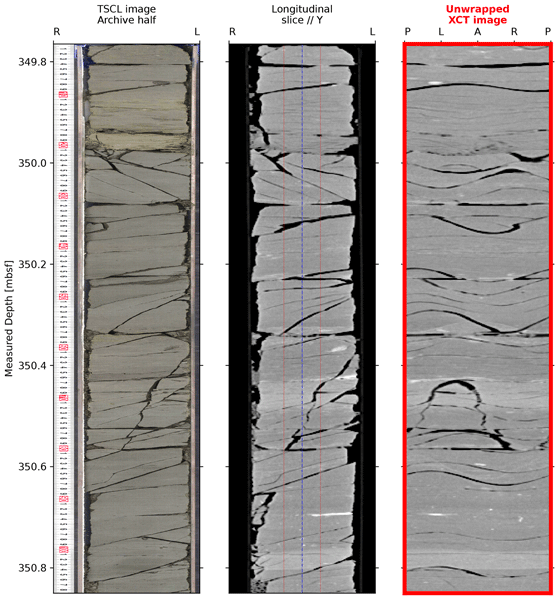
State-of-the-art scientific drilling frequently involves X-ray scanning to get an initial overview of the recovered cores. The X-ray scanner generates a huge 3D image, usually explored with a specialized computer located several meters away from the cores. We suggest using paper summaries of the X-ray images for a more focused description without digital distractions. In particular, we propose creating a virtual image that wraps around the core, similar to how the Shroud of Turin shows a body.
Mai-Linh Doan, Morgane Brunet, Charlotte Pizer, Hanaya Okuda, Yu-Chun Chang, Sara Satolli, Uisdean Nicholson, Yuzuru Yamamoto, Marianne Conin, Rina Fukuchi, Jamie Kirkpatrick, Sean Toczko, and the IODP Expedition 405 Scientists
Sci. Dril., 35, 55–60, https://doi.org/10.5194/sd-35-55-2026, https://doi.org/10.5194/sd-35-55-2026, 2026
Short summary
Short summary
State-of-the-art scientific drilling frequently involves X-ray scanning to get an initial overview of the recovered cores. The X-ray scanner generates a huge 3D image, usually explored with a specialized computer located several meters away from the cores. We suggest using paper summaries of the X-ray images for a more focused description without digital distractions. In particular, we propose creating a virtual image that wraps around the core, similar to how the Shroud of Turin shows a body.
Ken Ikehara, Michael Strasser, and Lena Maeda
Proc. Int. Ocean Drill. Prog., 503, 1–18, https://doi.org/10.5194/piodp-503-1-2025, https://doi.org/10.5194/piodp-503-1-2025, 2025
Short summary
Short summary
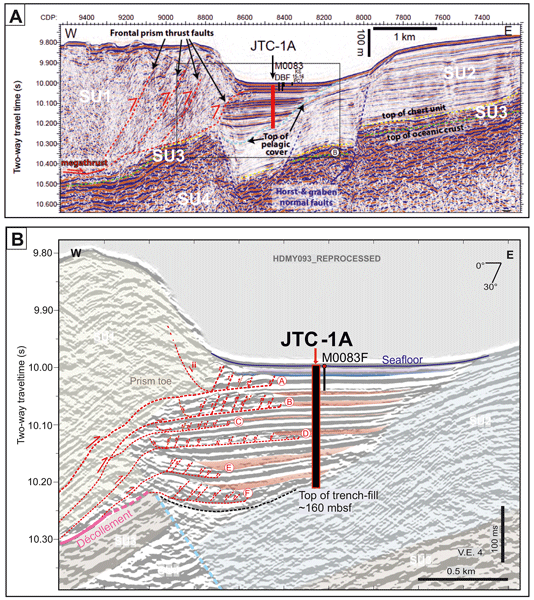
Unexpected shallow and large slip on the plate boundary fault during the 2011 Tōhoku-oki earthquake contributed to a large tsunami. However, our knowledge on the past history of such slips is limited due to the long recurrence interval of the events. IODP3 Expedition 503 recovers the whole trench-fill sequence in the central Japan Trench to understand the nature and recurrence of hadal trench tsunamigenic slips and their earthquake-related carbon accumulation and element cycles.
Marcel Ortler, Achim Brauer, Stefano C. Fabbri, Jean Nicolas Haas, Irka Hajdas, Kerstin Kowarik, Jochem Kueck, Hans Reschreiter, and Michael Strasser
Sci. Dril., 33, 1–19, https://doi.org/10.5194/sd-33-1-2024, https://doi.org/10.5194/sd-33-1-2024, 2024
Short summary
Short summary
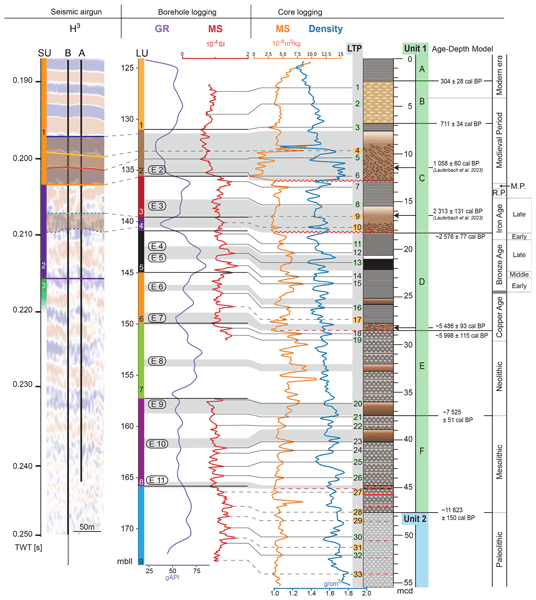
The lake drilling project at Lake Hallstatt (Austria) successfully cored 51 m of lake sediments. This was achieved through the novel drilling platform Hipercorig. A core-log seismic correlation was created for the first time of an inner Alpine lake of the Eastern Alps. The sediments cover over 12 000 years before present with 10 (up to 5.1 m thick) instantaneous deposits. Lake Hallstatt is located within an UNESCO World Heritage area which has a rich history of human salt mining.
Patrick Oswald, Michael Strasser, Jens Skapski, and Jasper Moernaut
Nat. Hazards Earth Syst. Sci., 22, 2057–2079, https://doi.org/10.5194/nhess-22-2057-2022, https://doi.org/10.5194/nhess-22-2057-2022, 2022
Short summary
Short summary
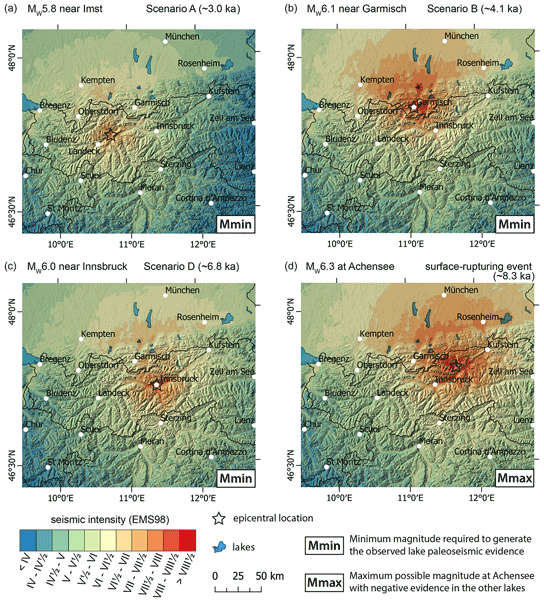
This study provides the first regional earthquake catalogue of the eastern Alps spanning 16 000 years by using three lake paleoseismic records. Recurrence statistics reveal that earthquakes recur every 1000–2000 years in an aperiodic pattern. The magnitudes of paleo-earthquakes exceed the historically documented values. This study estimates magnitude and source areas for severe paleo-earthquakes, and their shaking effects are explored in the broader study area.
Hamed Amiri, Francesco Cappuccio, Mai-Linh Doan, Marianne Conin, and Virginia Toy
Solid Earth Discuss., https://doi.org/10.5194/se-2021-150, https://doi.org/10.5194/se-2021-150, 2022
Publication in SE not foreseen
Short summary
Short summary
In March 2011, the Mw ~9 Tohoku-oki earthquake, one of the largest seismic events ever recorded, occurred across a megathrust fault in the west of the Japan trench. This devastating earthquake stressed the need for more detailed studies on the fault zone behavior and the main causes of this event.
Carolin Kiefer, Patrick Oswald, Jasper Moernaut, Stefano Claudio Fabbri, Christoph Mayr, Michael Strasser, and Michael Krautblatter
Earth Surf. Dynam., 9, 1481–1503, https://doi.org/10.5194/esurf-9-1481-2021, https://doi.org/10.5194/esurf-9-1481-2021, 2021
Short summary
Short summary
This study provides amphibious investigations of debris flow fans (DFFs). We characterize active DFFs, combining laser scan and sonar surveys at Plansee. We discover a 4000-year debris flow record in sediment cores, providing evidence for a 7-fold debris flow frequency increase in the 20th and 21st centuries, coincident with 2-fold enhanced rainstorm activity in the northern European Alps. Our results indicate climate change as being the main factor controlling debris flow activity.
Cited articles
Boiger, R., Churakov, S. V., Llagaria, I. B., Kosakowski, G., Wüst, R., and Prasianakis, N. I.: Direct mineral content prediction from drill core images via transfer learning, Swiss. J. Geosci., 117, 8, https://doi.org/10.1186/s00015-024-00458-3, 2024.
Carlson, W. D.: Three-dimensional imaging of earth and planetary materials, Earth Planet. Sci. Lett., 249, 133–147, https://doi.org/10.1016/j.epsl.2006.06.020, 2006.
Doan, M.-L., Brunet, M., Pizer, C., Okuda, H., Chang, Y.-C., Satolli, S., Nicholson, U., Yamamoto, Y., Conin, M., Fukuchi, R., Kirkpatrick, J., Toczko, S., and the IODP Expedition 405 Scientists: Real-time unwrapping of 3D X-ray CT scans for visual core description, Sci. Dril., 35, 55–60, https://doi.org/10.5194/sd-35-55-2026, 2026.
Emmanouilidis, A., Messaris, G., Ntzanis, E., Zampakis, P., Prevedouros, I., Bassukas, D. A., and Avramidis, P.: CT scanning, X-ray fluorescence: Non-destructive techniques for the identification of sedimentary facies and structures, Revue de Micropaléontologie, 67, 100410, https://doi.org/10.1016/j.revmic.2020.100410, 2020.
Gupta, L. P., Tanikawa, W., Hamada, Y., Hirose, T., Ahagon, N., Sugihara, T., Abe, N., Nomura, S., Masaki, Y., Wu, H. Y., Lin, W., Kinoshita, M., Yamada, Y., and NGHP Expedition 02 JAMSTEC Science Team: Examination of gas hydrate-bearing deep ocean sediments by X-ray Computed Tomography and verification of physical property measurements of sediments, Mar. Petro. Geol., 108, 239–248, https://doi.org/10.1016/j.marpetgeo.2018.05.033, 2019.
Hounsfield, G. N.: Computerized transverse axial scanning (tomography): Part 1. Description of system, Brit. J. Rad., 46, 1016–1022, https://doi.org/10.1259/0007-1285-46-552-1016, 1973.
Ikehara, K., Strasser, M., and Maeda, L.: IODP3 Expedition 503 “Hadal Trench Tsunamigenic Slip History” Scientific Prospectus, Proc. Int. Ocean Drill. Prog., 503, 1–18, https://doi.org/10.5194/piodp-503-1-2025, 2025.
IODP3 Depth Scale Terminology: https://iodp3.org/documents/iodp3-depth-scale-terminology/ (last access: 15 May 2026), 2025.
Kirkpatrick, J., Fulton, P., Ujiie, K., Conin, M., Regalla, C., Kodaira, S., Okutsu, N., Maeda, L., Toczko, S., Eguchi, N., Bellanova, P., Brown, C., Brunet, M., Castillo, M., Chang, Y.-C., Doan, M.-L., Everard, J., Fintel, A., Ford, J., Fukuchi, R., Gough, A., Guo, H., Gürer, D., Hackney, R., Hagino, M., Hamada, Y., Hosono, H., Ijiri, A., Ikari, M., Ishikawa, T., Iwai, M., Jeppson, T., Jurado, M.-J., Kamiya, N., Kanamatsu, T., LaPlante, A., Lin, W., Miyakawa, A., Morono, Y., Nakamura, Y., Nicholson, U., Okuda, H., Pei, P., Pizer, C., Rasbury, T., Robertson, R. V. M., Ross, C., Satolli, S., Savage, H., Schaible, K., Shreedharan, S., Sone, H., Sun, C., Turel, C., Uchida, T., Yamaguchi, A., Yamamoto, Y., Yoshimoto, T., Zhang, J., Wspanialy, A., Le Ber, E., Rydzy, M. B., and Schuba, N.: Expedition 405 methods, in: Tracking Tsunamigenic Slip Across the Japan Trench (JTRACK), edited by: Kodaira, S., Conin, M., Fulton, P., Kirkpatrick, J., Regalla, C., Ujiie, K., Okutsu, N., Maeda, L., Toczko, S., Eguchi, N., and the Expedition 405 Scientists, Proc. Int. Ocean Discov. Prog., 405, https://doi.org/10.14379/iodp.proc.405.102.2025, 2025.
Okuda, H.: Python script for XCT visualization on D/V Chikyu, Mendeley Data [code], https://doi.org/10.17632/dyb6t5b9gm.1, 2026.
Reilly, B. T., Stoner, J. S., and Wiest, J.: SedCT: MATLAB™ tools for standardized and quantitative processing of sediment core computed tomography (CT) data collected using a medical CT scanner, Geochem. Geophys. Geosyst., 18, 3231–3240, https://doi.org/10.1002/2017GC006884, 2017.
Strasser, M., Ikehara, K., Pizer, C., Itaki, T., Satoguchi, Y., Kioka, A., McHugh, C., Proust, J.-N., Sawyer, D., IODP Expedition 386 Expedition Management Team, and IODP Expedition 386 Expedition Science Party: Japan Trench event stratigraphy: First results from IODP giant piston coring in a deep-sea trench to advance subduction zone paleoseismology, Mar. Geol., 477, 107387, https://doi.org/10.1016/j.margeo.2024.107387, 2024.
Titschack, J., Baum, D., De Pol-Holz, R., López Correa, M., Forster, N., Flögel, S., Hebbeln, D., and Freiwald, A.: Aggradation and carbonate accumulation of Holocene Norwegian cold-water coral reefs, Sedimentology, 62, 1873–1898, https://doi.org/10.1111/sed.12206, 2015.
Titschack, J., Fink, H. G., Baum, D., Wienberg, C., Hebbeln, D., and Freiwald, A.: Mediterranean cold-water corals – an important regional carbonate factory?, Depo. Rec., 2, 74–96, https://doi.org/10.1002/dep2.14, 2016.
Tonai, S., Kubo, Y., Tsang, M-.Y., Bowden S., Ide, K., Hirose, T., Kamiya, N., Yamamoto, Y., Yang, K., Yamada, Y., Morono, Y., Heuer, V. B., Inagaki, F., and Expedition 370 Scientists: A new method for quality control of geological cores by X-ray computed tomography: application in IODP Expedition 370, Front. Earth Sci., 7, 117, https://doi.org/10.3389/feart.2019.00117, 2019.
Vandorpe, T., Collart, T., Cnudde, V., Lebreiro, S., Hernández-Molina, F. J., Alonso, B., Mena, A., Antón, L., and Van Rooij, D.: Quantitative characterisation of contourite deposits using medical CT, Mar. Geol., 417, 106003, https://doi.org/10.1016/j.margeo.2019.106003, 2019.
Williams, J. N., Toy, V. G., Massiot, C., McNamara, D. D., and Wang, T.: Damaged beyond repair? Characterising the damage zone of a fault late in its interseismic cycle, the Alpine Fault, New Zealand, J. Struct. Geol., 90, 76–94, https://doi.org/10.1016/j.jsg.2016.07.006, 2016.
Yamaguchi, A., Kitajima, H., and Okutsu, N.: IODP3 Expedition 502 “Impact of Petit-Spot Magmatism on Subduction Zone Seismicity and Global Geochemical Cycles” Scientific Prospectus, Proc. Int. Ocean Drill. Prog., 502, 1–11, https://doi.org/10.5194/piodp-502-1-2026, 2026.
Yan, Y. T., Chua, S., DeCarlo, T. M., Kempf, P., Morgan, K. M., and Switzer, A. D.: Core-CT: A MATLAB application for the quantitative analysis of sediment and coral cores from X-ray computed tomography (CT), Comput. Geosci., 156, 104871, https://doi.org/10.1016/j.cageo.2021.104871, 2021.
Zonta, R., Fontolan, G., Cassin, D., and Dominik, J.: X-ray Computed Tomography as a Tool for Screening Sediment Cores: An Application to the Lagoons of the Po River Delta (Italy), J. Mar. Sci. Eng., 9, 323, https://doi.org/10.3390/jmse9030323, 2021.
Short summary
X-ray computed tomography scans have been used to look inside drill cores without destroying them. On the drilling vessel Chikyu, drill cores are routinely scanned by X-ray computed tomography, but the usage of scan data has been limited on the vessel due to large data size, unfamiliar data format, etc. In this study, we designed a workflow that enables shipboard scientists to access and utilize the X-ray computed tomography data quickly for shipboard core handling.
X-ray computed tomography scans have been used to look inside drill cores without destroying...