

the Creative Commons Attribution 4.0 License.
the Creative Commons Attribution 4.0 License.
 | 21 Sep 2026
GRIND-ECT: geological research through integrated Neoproterozoic drilling – Ediacaran–Cambrian transition
Catherine V. Rose

Simone A. Kasemann
Francis A. Macdonald
Melanie Mesli
Andreas Nduutepo
Ricardo Trindade
Maoyan Zhu
Anthony R. Prave
GRIND (Geological Research through Integrated Neoproterozoic Drilling), sponsored by the International Continental Scientific Drilling Program (ICDP), aims to create a core archive of the Neoproterozoic Era via three phases: Tonian (GRIND-TON), Cryogenian (GRIND-CRY), and Ediacaran–Cambrian Transition (GRIND-ECT). The latter is the first phase undertaken and focuses on the geological and biogeochemical context of Late Ediacaran environmental perturbations and biological turnovers that culminated in the Cambrian Explosion. Mixed siliciclastic–carbonate successions of Namibia, Brazil, and China were chosen as GRIND-ECT targets. Here we report on the completed Namibian and Brazilian components. The Namibian stratigraphy drilled consists of the Kuibis–Schwarzrand sub-groups of the late Ediacaran–early Cambrian Nama Group on the western margin of the Kalahari craton in southern Namibia. These strata contain a rich record of Ediacaran fauna, including Cloudina and related small calcifiers, and simple to complex trace fossils that inhabited environments spanning shorelines to deeper-marine ramps. In addition, cores were drilled through the Late Ediacaran Corumbá Group in Brazil, which records a marine carbonate platform developed along the southeastern margin of the Amazon craton. These units are marked by a transition from a rimmed shelf to a distally steepened ramp and host the first appearance of Cloudina in Brazil and a myriad of acritarchs and trace fossils. Collectively, six Namibian cores totalling 2379 m and two Brazilian cores totalling 306 m were drilled. All cores were split and fully characterized and are housed at the Bundesanstalt für Geowissenschaften und Rohstoffe, Berlin–Spandau, Germany, and either at the Ministry of Mines in Windhoek, Namibia, or at the Universidade de São Paulo, Brazil. Ongoing efforts are integrating stable isotope and redox-sensitive element geochemistry and U–Pb and Re–Os geochronology throughout these cores, with detailed facies analyses to reconstruct the conditions under which metazoa expanded; diversified; and, in some cases, went extinct. GRIND-ECT cores offer exceptional opportunities to create and test hypotheses about the causes and consequences of Earth system transformation during the evolution of animals.
- Article
(25300 KB) - Full-text XML
- BibTeX
- EndNote


In 2014, 44 scientists from 14 countries attended a workshop at the British Geological Survey to define an ambitious research initiative: GRIND – Geological Research through Integrated Neoproterozoic Drilling (Condon et al., 2015). The aim was to obtain a core archive of the finest rock records through the Neoproterozoic Era (1000–538.8 ± 0.6 Ma) that record when metazoans first appeared and evolved (Love et al., 2009; Erwin, 2015; Erwin et al., 2011), the rise of marine planktonic algae (Brocks et al., 2017), and when biomineralization became widespread (Wood and Zhuravlev, 2012; Darroch et al., 2018). Furthermore, a supercontinent broke apart, and a new one formed (Li et al., 2008); marine oxygen concentrations rose to near-present-day levels (Reinhard et al., 2016; Cole et al., 2020); the global carbon cycle underwent high-amplitude fluctuations (Halverson et al., 2010); and ice covered the Earth during two Snowball Earth glaciations (Hoffman et al., 2017). In 2018, the International Continental Scientific Drilling Program (ICDP) accepted GRIND and its three-phased programme: GRIND-ECT – Ediacaran–Cambrian Transition and expansion of animals (ca. 630–520 Ma); GRIND-CRY – Cryogenian Snowball Earth and rise of animals (ca. 720–630 Ma); and GRIND-TON – Tonian time and inception of the Cryogenian (ca. 1000–720 Ma). The Central Science Team and participating scientists at the initial ICDP workshop made the unanimous decision to undertake GRIND-ECT first, followed by GRIND-CRY and then GRIND-TON.
Three successions were identified for GRIND-ECT: the Nama Group in Namibia, the Corumbá Group in Brazil, and the Yangtze Platform of South China. These successions are ideal for Ediacaran stratigraphy because they preserve thick, laterally continuous sequences with minimal structural disturbance, as well as datable volcanic horizons, enabling high-resolution chemostratigraphic, palaeontological, and geochronological correlation. This report highlights the drilling activities and outcomes of the Namibian and Brazilian phases. A further report will detail the Chinese phase upon completion. The Chinese phase has been hampered by COVID-related delays and restrictions, but drilling commenced in early to mid-2024, targeting the Yangtze platform-to-basin succession (e.g. Zhu et al., 2007; Xiao et al., 2013; Fan et al., 2018; Yang et al., 2021).
The appearance and diversification of animals ca. 650–500 million years ago constitute one of the most profound episodes in the evolution of Earth's ecosystems. Coined by Darwin as the “Cambrian Explosion”, its genesis has intrigued scientists since the publication of the Origin of Species (1859). The key objectives of GRIND-ECT are to determine the style, tempo, mode, and biogeochemical causes and consequences of the “long fuse” to the Cambrian Explosion, considered by many to be one of science's great unresolved challenges (Erwin et al., 2011). GRIND-ECT cores will give researchers the required geological, geochemical, geobiological, and geochronological dataset to obtain the necessary stratigraphic completeness, sufficient palaeogeographic distribution, and ability to create a sufficiently fine temporal resolution to answer the fundamental questions surrounding the lead up to and genesis of the Cambrian Explosion:
-
What were the temporal and spatial patterns of marine oxygenation; what processes may have driven them; and, collectively, do they represent a Neoproterozoic oxygenation event?
-
What were the timing, duration, and causal mechanisms for the large-amplitude C-isotope excursions that mark Ediacaran and early Cambrian strata?
-
What were the timing and rates of the advent, expansion, and extinction of Ediacaran biota?
-
What were the environmental context and timing for changing skeletal mineralogy and diversification of biomineralizing metazoa?
-
Is the Ediacaran–Cambrian boundary a synchronous, worldwide biological event or a relatively lengthy episode of progressive biological innovation?
Günzel Drilling was the contractor in Namibia that undertook drilling and coring work in two phases in September–November 2019 (1A–1G) and May 2022 (1H) (Table 1). The skill of their team was outstanding, attaining > 95 % recovery for more than 2379 m of HQ core, averaging 50 m of core per day, using re-circulated water mixed as a lubricant and avoiding chemical-based fluids, restoring drill sites to exceptional environmental conditions, and organizing logistical support. The Namibian Geological Survey helped in procuring permit applications and staff to help at drill sites. Six cores and all on-site scientific work was achieved in 12 h shifts per day with three scientists on site at any time during the operational phase. The core-handling procedure was conducted following a set workflow by the drilling team and on-site science team (Fig. 1). The Namibian phase was chosen for transitioning ICDP's database system DIS (Drilling Information System) to mDIS. Together, ICDP colleagues and GRIND researchers oversaw the field-based installation and initial testing of the DIS-mDIS systems. There was no on-site sampling of the drill core.
Table 1Drill site localities for the Kuibis and Schwarzrand sub-groups, southern Namibia.
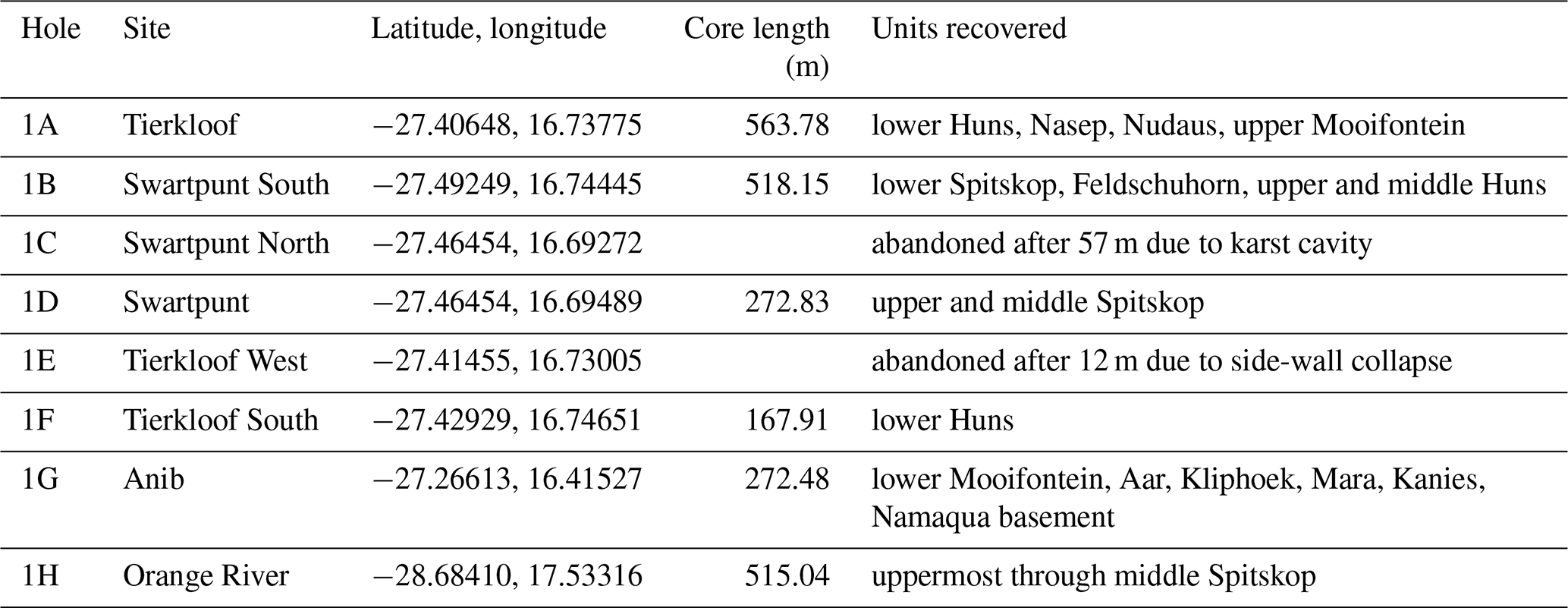
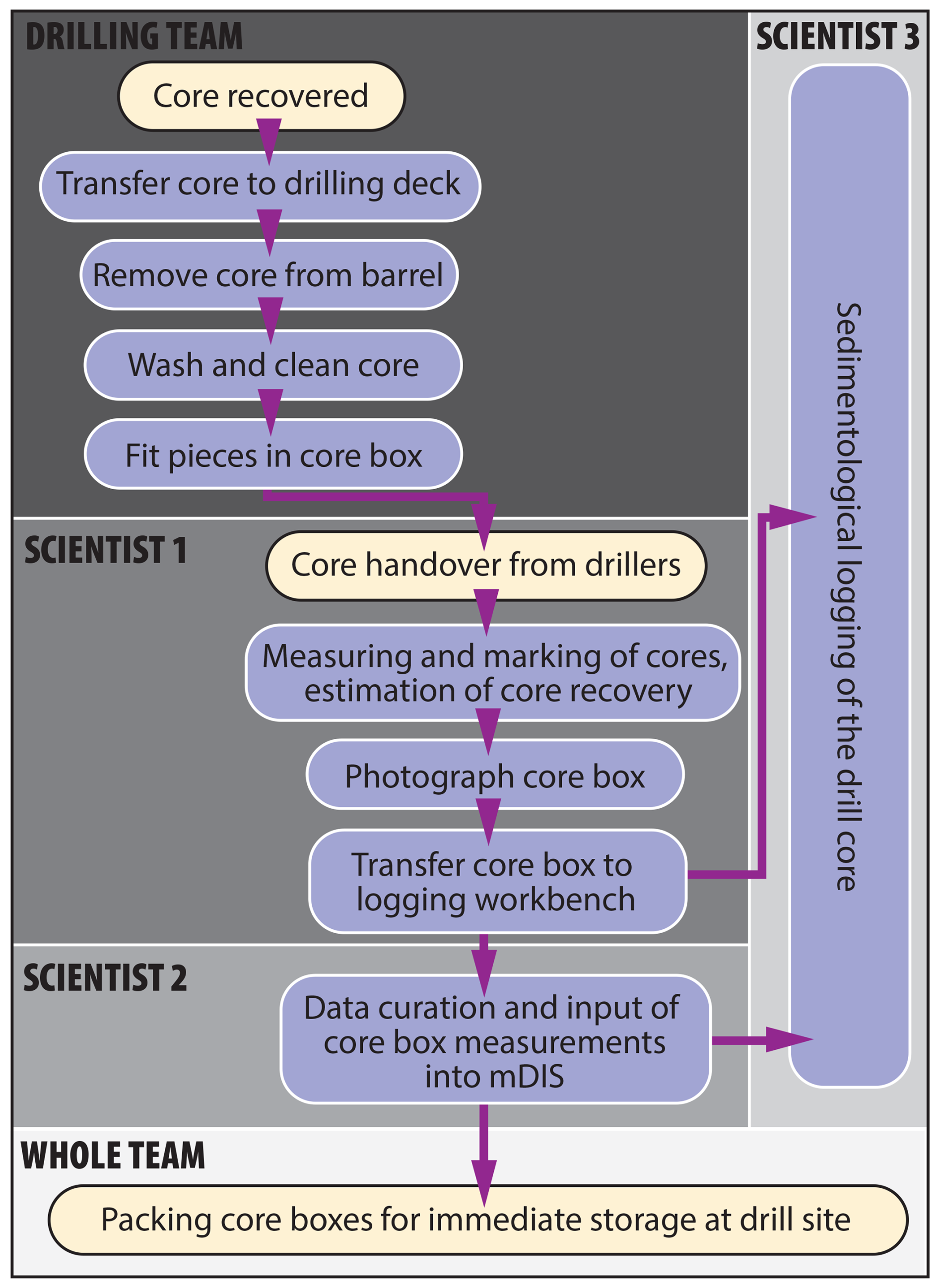
Figure 1Flowchart illustrating the GRIND-ECT drill core processing workflow at the drill sites in Namibia and Brazil.
Roquesonda was the contractor that undertook drilling and coring work in Brazil. The team attained > 95 % recovery for the 306 m of HQ core using re-circulated water mixed as a lubricant and avoiding chemical-based fluids (Table 2). The same on-site scientific workflow used in Namibia was adopted for the two Brazil drill sites (Fig. 1). For all drill sites, the boreholes were drilled perpendicular to bedding, and no core orientation was performed. Measured depth can be considered to be broadly equivalent to true stratigraphic thickness. No geophysical logging was conducted in either project. The well-constrained, “layer-cake” stratigraphy – supported by extensive outcrops, detailed measured sections, and prior mapping – already provided a robust framework, and additional downhole geophysical data were not necessary for meeting the project's scientific objectives.

All cores from Namibia and Brazil were shipped to the Bundesanstalt für Geowissenschaften und Rohstoffe (BGR) core archive in Berlin–Spandau, Germany. As part of the GRIND agreement, split halves of those cores will be returned to home nations for in-country training and future study. The first core characterization and sampling party (August–September 2022) involved 28 researchers and the collection of 2794 samples for a broad suite of geochemical, micropalaeontological, and geochronological analyses. These include high-resolution core imagery; stable isotope measurements (C, N, S, Sr, U, Ca, B, Cr, K, Li, Mo, Mg, P); total organic carbon (TOC) and/or total inorganic carbon (TIC); major, trace, and rare earth element (REE) geochemistry; Fe and P speciation; detrital zircon and ash-bed geochronology; carbonate dating; palaeomagnetism and magnetic susceptibility; and micropalaeontology. A further two sample parties were run to obtain additional higher-resolution geochemical data (May 2023 and September 2024).
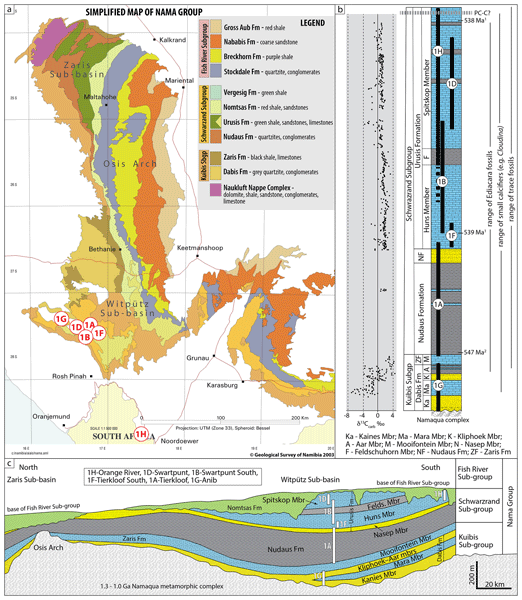
The lower part of the Nama Group, the Kuibis–Schwarzrand rocks in the Witpütz Sub-basin, was the target of GRIND-ECT in Namibia (Fig. 2). Since the early 20th century, these rocks were known to contain a rich record of simple to complex trace fossils, small shelly fossils, and impressions of large soft-bodied organisms (Ediacara fauna) that predate the first marine invertebrates (Germs, 1972; Grotzinger et al., 1995; Narbonne et al., 1997; Jensen et al., 2000; Wood et al., 2019; Darroch et al., 2016, 2021, 2025). The succession also records carbonate carbon isotope and redox-sensitive element ratio excursions that have been related to biogeochemical linkages between global ocean redox state, ocean–atmosphere oxygenation levels, and animal evolution (Saylor et al., 1998; Wood et al., 2015, 2019; Darroch et al., 2020; Bowyer et al., 2022; Nelson et al., 2022). Furthermore, numerous volcanic tuffs enable detailing of the timings, rates, and durations of, as well as the creation of an age model for, the biological and geochemical events of the late Ediacaran–early Cambrian time (Linnemann et al., 2019; Bowyer et al., 2022; Nelson et al., 2022). Equally important criteria were those for de-risking drilling. Strata in the Witpütz Sub-basin are flat lying to gently dipping, with minimal deformation, most of which is in the form of widely spaced sub-vertical normal faults (Fig. 3). These traits minimized uncertainty about drilling subsurface targets. Further, proximity of excellent surface outcrops to the drill sites enables the linking of cores to geological and sedimentary features that can be identified and mapped over large areas, thereby giving confidence to core-based descriptions and interpretations.
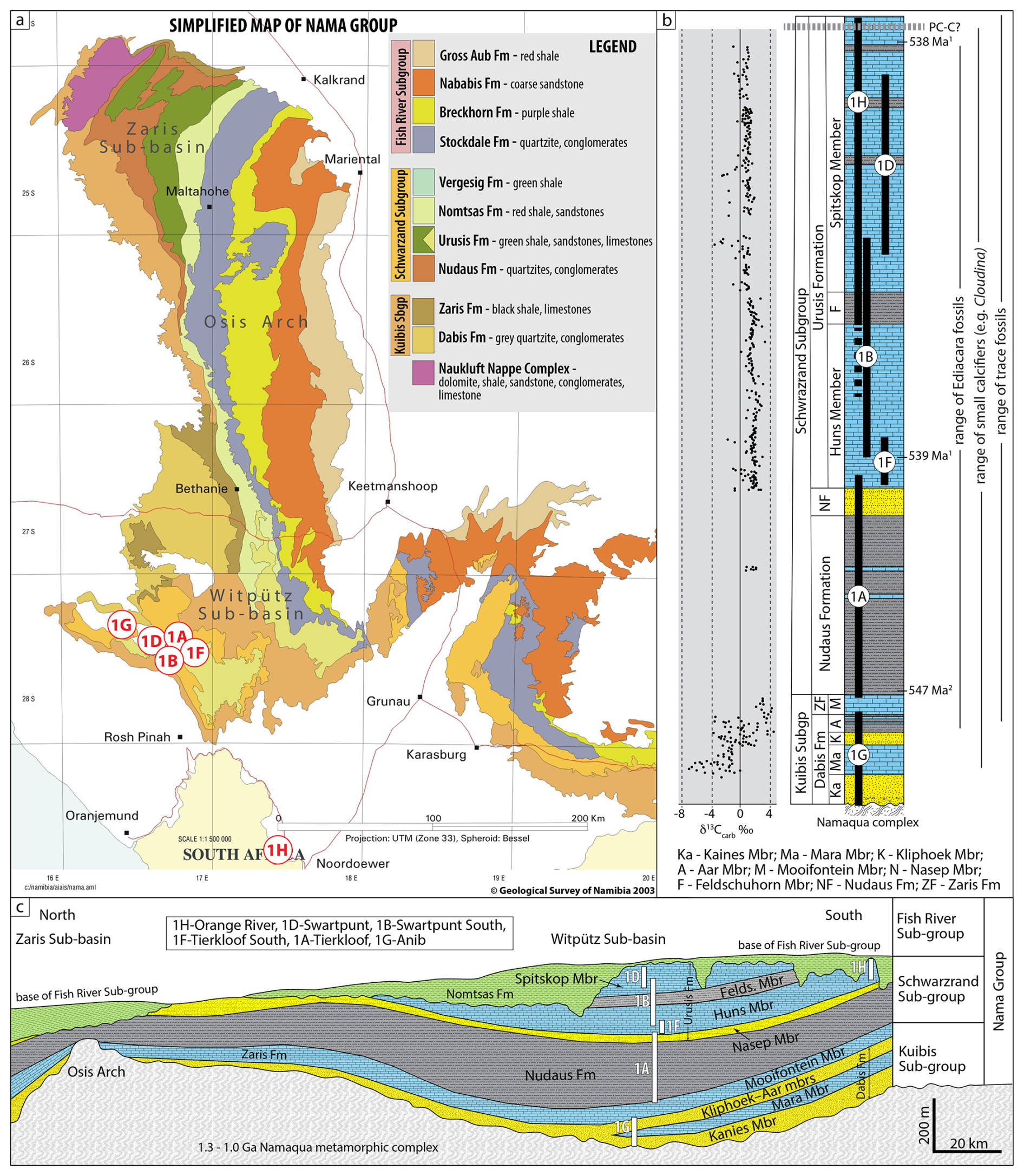
Figure 2(a) Simplified Nama Group map and GRIND-ECT locations in southern Namibia (adapted from Schreiber et al., 1999). (b) Stratigraphy of Kuibis–Schwarzrand sub-groups and position of GRIND-ECT cores. Ages from Nelson et al. (2022) and Bowring et al. (2007; note that the 547 Ma age is from the Zaris Sub-basin and extrapolated to inferred correlative strata in the Nudaus Formation). C-isotope date from Wood et al. (2015) and Nelson et al. (2022) for the Kuibis and Schwarzrand sub-groups, respectively. (c) Simplified cross-section of the Nama Group (after Grotzinger and Miller, 2008) showing positions of GRIND-ECT cores.
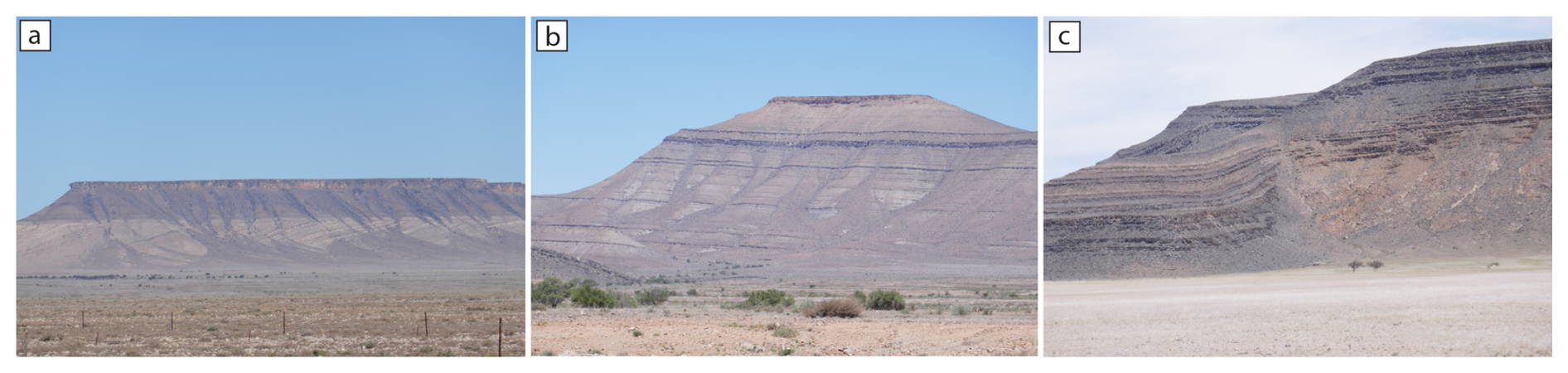
Figure 3(a) Flat-lying Kuibis Sub-group (on tilted Namaqua metamorphic complex) and (b) Schwarzrand rocks. (c) Sub-vertical planar normal fault (left centre of photo). These structures occur on many-km-scale spacings and remain planar into the subsurface; thus they can be identified and avoided when drilling.
4.1 The Nama Group
The Nama Group is a siliciclastic–carbonate succession 2–3 km thick that was deposited mostly as a foreland basin fill. The basin formed during the 560–530 Ma Damaran and Gariep orogenies, part of the Pan-African amalgamation of Gondwana marked by the arc-collision of terranes in the Dom Feliciano belt, followed by continent–continent collisions of the Congo, Rio de la Plata, and Kalahari cratons (Germs, 1983; Saylor et al., 1998; Grotzinger and Miller, 2008; Gray et al., 2008). The Nama Group rests unconformably on the 1.3–1.0 Ga Namaqua metamorphic complex and the 0.8–0.6 Ga Port Nolloth Group and infills a palaeotopographic relief that divides the basin into the northern Zaris and southern Witpütz sub-basins, separated by the Osis Arch (Fig. 2c). The basal deposits (Kanies Member of the Dabis Formation), typically a few tens of metres thick, are feldspathic–quartzitic sandstones of fluvial–deltaic systems formed along the Kalahari craton. These pass upward into a 1–2 km thick succession (Dabis–Zaris–Nudaus–Urusis formations) of orogen-derived flysch (fine-grained sandstone, shale) interfingering with basinward-prograding, shallow-marine carbonate ramps. In turn, those rocks give way to a ca. 1 km thick, late- to post-orogenic basin-filling molasse of fluvio-deltaic siliciclastic rocks (Fish River Sub-group).
Age constraints are based on U-Pb dating of zircon from syn-depositional volcanic tuffs interpreted as airfall ashes. The precise position of the Ediacaran–Cambrian boundary in the Nama Group remains debated, with younger tuff ages in the Nomtsas and the possibility that the FAD of Treptichnus pedum lies at the base of the Fish River Sub-group (Nelson et al., 2026). However, the Spitskop Member was chosen as the stratigraphically highest unit for drilling because, at the time the project was funded in 2019, it represented the youngest stratigraphy that could be reliably correlated with underlying units. The currently youngest dated tuff has a U236–Pb208 zircon age of 538.57 ± 0.01 Ma and occurs near the top of the Spitskop Member in the Neint Nababeep Plateau in nearby South Africa (Nelson et al., 2022). This age concurs with those of 539.64 ± 0.19 Ma (Bowyer et al., 2022) and 538.99 ± 0.21 Ma (Linnemann et al., 2019) obtained for tuffs in correlative strata in the Witpütz Sub-basin. The exact correlation of these tuffs remains uncertain; tuffs recovered in the GRIND-ECT cores will help refine these age models. The oldest tuff sampled from strata in the Witpütz Sub-basin is in the lower Huns Member and yielded a U236–Pb208 zircon age of 539.63 ± 0.15 Ma (Nelson et al., 2022), whereas the currently oldest known tuff is in the Zaris Sub-basin, dated at 547.36 ± 0.23 Ma (Bowring et al., 2007). Based on C-isotope correlations, that age has been extrapolated to the lower part of the Nudaus Formation in the Witpütz Sub-basin (Hall et al., 2013; Elliott et al., 2016).
Late Ediacaran carbon isotope records show several globally recognized excursions – most notably the BACE (Basal Cambrian Excursion) and, less consistently, the ENCE (Ediacaran Negative Carbon Excursion) – that bracket the terminal Ediacaran to earliest Cambrian interval just before the formally defined Ediacaran–Cambrian boundary (∼ 541 Ma). The BACE is characterized by a δ13C nadir of roughly −5 ‰ to −10 ‰ before recovery, and its lowest values consistently predate the FAD of Treptichnus pedum, coinciding with major biotic turnover. The ENCE occurs slightly earlier in the late Ediacaran and is typically characterized by δ13C values ranging from −5 ‰ to −12 ‰, often associated with regional facies changes and the decline of certain Ediacaran taxa. In the Nama Group, correlations hinge on where these excursions appear or are absent, and the lack of a clear BACE in the Schwarzrand Sub-group has been used to suggest that the E–C boundary may lie higher in the succession than traditionally assumed. Carbon isotope chemostratigraphy of the Kuibis–Schwarzrand carbonate rocks (Fig. 2b) has been used in interpretations of the Ediacaran global carbon cycle, marine oxygenation, and mass balance between organic productivity and organic carbon burial (e.g. Wood et al., 2015; Cole et al., 2020; Nelson et al., 2022). Further, efforts utilizing C-isotope profiles as a means of establishing global correlations have highlighted the negative-to-positive trend in the Mara Member as a potential rising limb linked to the Shuram–Wonoka excursion of late Ediacaran time (e.g. Saylor et al., 1998; Wood et al., 2015), but this linkage remains to be tested. In sections worldwide, negative carbonate–carbon isotope excursions frame the Ediacaran–Cambrian boundary (e.g. Brasier et al., 1996; Zhu et al., 2007; Wood et al., 2019). Although radiometric ages and palaeontological trends suggest that the uppermost strata of the Spitskop Member may contain that boundary (Grotzinger et al., 1995; Linnemann et al., 2019), the accompanying excursions have not yet been identified. This raises questions about the global-versus-regional nature of those C-isotope excursions and their utility in basin-to-basin correlations (Nelson et al., 2022). The continuous rock record obtained by GRIND-ECT cores offers a means of creating a more finely resolved C-isotope chemostratigraphy in the context of a high-resolution age model.
4.2 GRIND-ECT cores 1A through 1G
The six correlated cores through the Kuibis and Schwarzrand strata (Figs. 4–10) were characterized in detail in the field and at BGR, where the cores were split and scanned. All the stratigraphic and sample data are stored in ICDP's DIS system, and the core scans and analytical data are hosted on ICDP's website for access by GRIND-ECT researchers. Once the moratorium period ends (September 2025), these data will become open access to researchers worldwide. The drilling programme was designed to ensure that the cores overlapped (Fig. 2b, c). The only exception was the Mooifontein Member for which, due to accessibility issues and water shortages, only the lowermost and uppermost strata were cored and ca. 90 m of intervening stratigraphy was not drilled (see Fig. 4 for stratigraphic correlations).
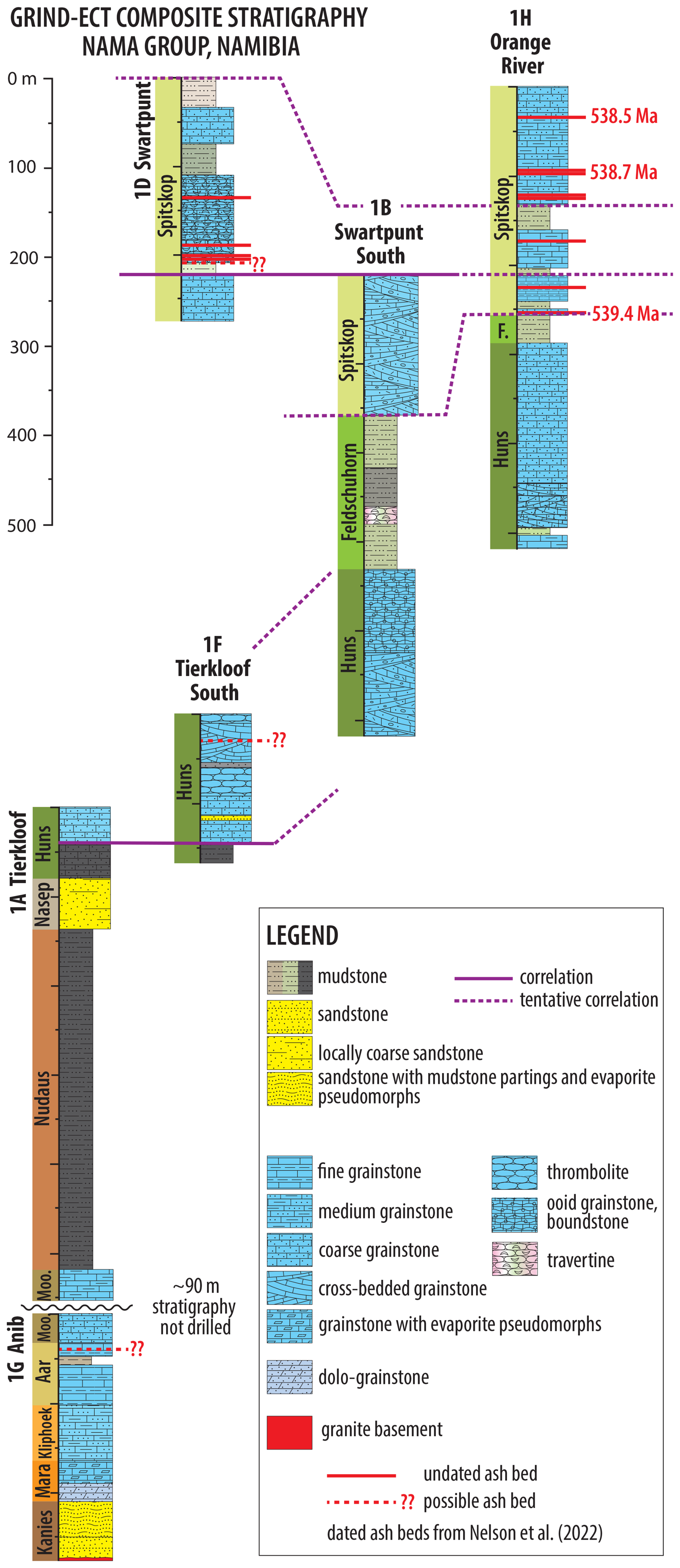
Figure 4Summary stratigraphy and correlation of the GRIND-ECT cores with dated ash bed ages from Nelson et al. (2022). Stratigraphic depth is shown in metres. Refer to Grotzinger and Miller (2008) to review lateral facies changes across the basin.
The oldest strata are captured in core 1G. The cored section starts in the basal Mooifontein Member and descends through the quartzite–shale–limestone of the fossil-bearing (soft-bodied macrofossils, calcitized small shelly fauna, simple traces) Aar, Kliphoek, and Mara members and the sandstone and shale of the Kaines Member to intersect the unconformable contact on the Namaqua metamorphic complex. Core 1A recovers grey to black shale and quartzites of the Nasep Formation and Nudaus Member ending in the upper part of the Mooifontein limestone. These shales typically weather green and lilac in outcrops, suggesting that this core may be an ideal target for Re–Os dating. Cores 1B, 1D, 1F, and 1H span the youngest stratigraphic units consisting of fossil-bearing (Cloudina, Namacalathus, complex traces, Ediacaran biota) limestones–micrites–shales of the Huns and Spitskop members separated by the green-grey shale of the Feldschuhorn Member. These members also contain interbedded tuffs, key targets for U–Pb zircon dating.
Core 1G – Anib (Fig. 5). This core is 272.48 m in length and recovers the oldest strata of the Nama Group. Overlying the unconformable contact on the Namaqua metamorphic complex, these are the mixed siliciclastic–carbonate rocks of the Kanies, Mara, Kliphoek, Aar, and lowermost Mooifontein members of the Kuibis Sub-group. This lower part of the Nama Group defines a succession that alternates between carbonate- and siliciclastic-dominated units. In outcrop, arkosic sandstone of the Kanies Member displays abundant trough cross-bedding with W-directed sediment transport directions and some bedding surfaces with desiccation cracks. Both observations support the inference that those rocks are mostly of fluvial origin (Saylor et al., 1995). The overlying Mara, Kliphoek, and Aar members consist of an interfingering mosaic of cross-bedded peloidal–ooidal–intraclastic grainstone–packstone–wackestone exhibiting ribbon rock and planar–wavy–crinkly lamination and lesser cross-bedded to planar-laminated fine- to coarse-grained quartzites. Bedding thickness varies from the centimetre to decimetre scale, and thin quartzite beds exhibit sharp bases and fining–upward grading. Calcite-replaced evaporite pseudomorphs (cauliflower blebs, incipient chicken wire fabric) of former sulfate minerals are present in the Mara Member (its lower part is dolomitized) and appear as relict structures in the finer-grained upper part of the Kanies Member. Combined, the facies features are indicative of shallow sub-tidal inner-mid ramp and, in places, inter-tidal settings.
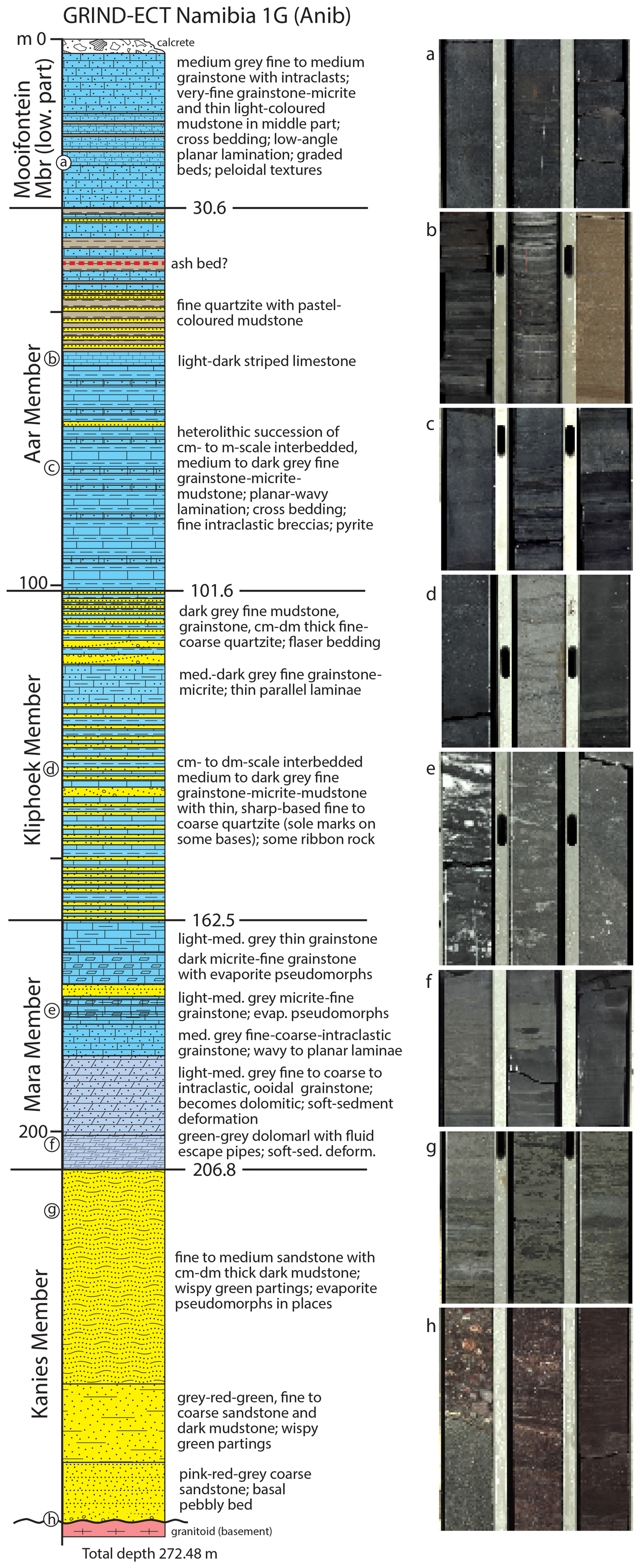
Figure 5Summary section of GRIND-ECT Core 1G (Anib); circled letters to the left of the column show the stratigraphic position of the core images. Cores are 63.5 mm in diameter (HQ). (a) Medium-grained to intraclastic low-angle cross-bedded grainstone. (b) Light-dark laminated limestone and medium-grained, low-angle-laminated (hummocky?) quartzite. (c) Thin-bedded laminated fine grainstone with flaser bedding and mud-draped cross-laminae interbedded with dark micrite partings/layers; note soft-sediment deformation. (d) Cross-bedded, light to red-grey, fine to coarse-grained quartzite; note mud drapes on cross laminae, reactivation surfaces, and possible bimodal cross-bed sets. (e) Dark- to light-grey, fine-grained to intraclastic grainstone with cross-bedding and abundant calcitized evaporite pseudomorph fabrics. (f) Green-grey dolomite and dark-grey fine-grained grainstone; note wispy soft-sediment deformation and presence of fluid pipes that likely were responsible for dolomitization. (g) Green-grey mudstone with wispy laminae and medium- to coarse-grained quartzite bed; note relict evaporite pseudomorphs. (h) Basal unconformity marked by cross-bedded pebbly to coarse-grained arkosic sandstone.
Core 1A – Tierkloof (Fig. 6). This core is 563.78 m in length and recovers the siliciclastic-dominated part of the lower Schwarzrand Sub-group that is mostly grey to black shale and the fine sandstone–quartzite of the Nudaus Formation and Nasep Member of the Urusis Formation. This interval records a consistently deeper, mid- to outer-ramp setting. In the outcrop, it is marked by pastel-weathering shales punctuated by ledge-forming metre-thick sandstone bodies overlain by the bulbous weathering Nasep Quartzite; in many places, the sandstone beds are hummocky and swaley stratified (Saylor et al., 1995). In the core, the interval is dominated by medium- to dark-grey and, less so, black shale with varying proportions of thin-bedded, commonly graded fine-grained quartzites. Intervals of flaser, lenticular, and pinstripe bedding and, in many places, soft-sediment deformation and centimetre-scale ptygmatically folded (compacted) injectite features are present. The Nasep Member is mostly a flat- to low-angle-laminated fine-grained quartzite with abundant mud partings and drapes on laminae and can be interpreted as a storm-influenced shallow-marine and shoreface deposit.
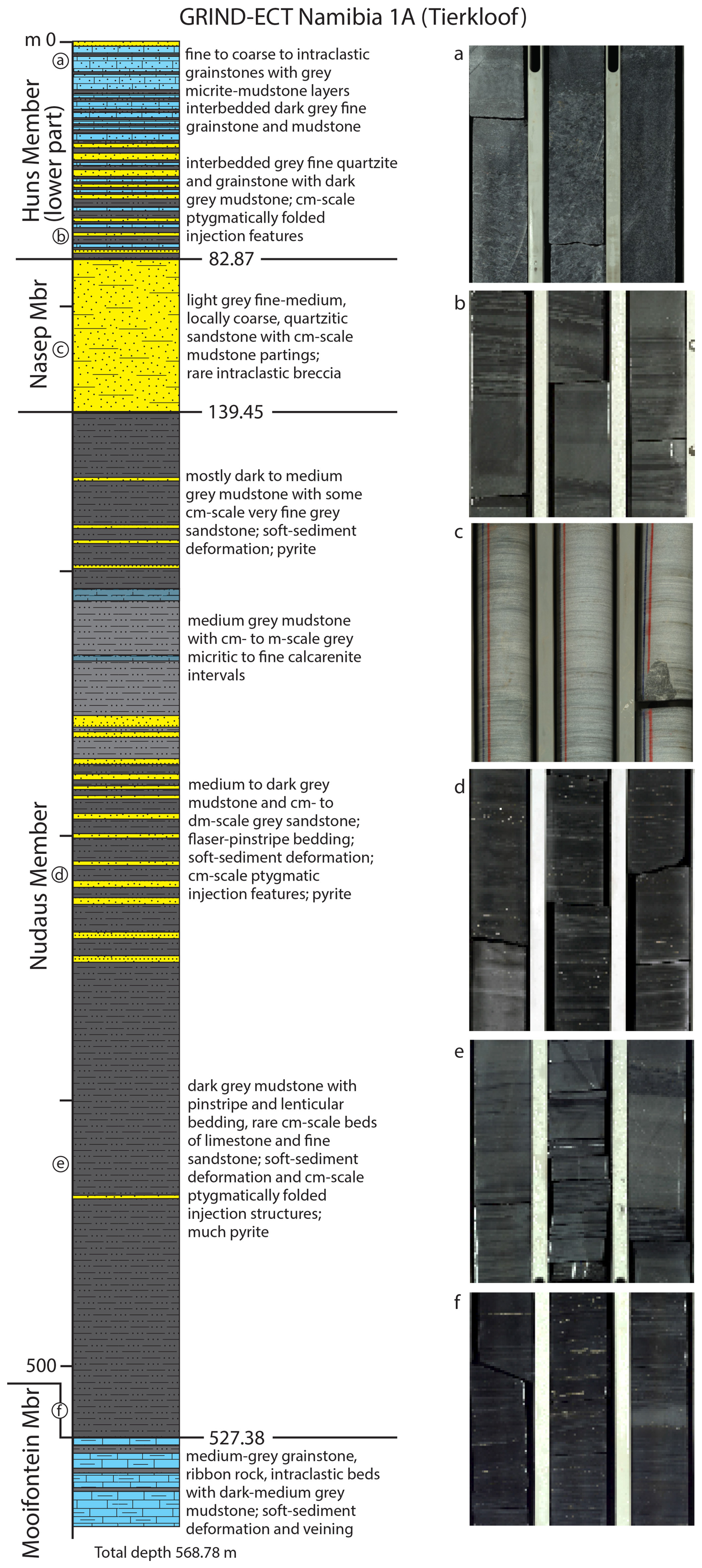
Figure 6Summary section of GRIND-ECT Core 1A (Tierkloof); circled letters to the left of the column show stratigraphic position of the core images. Cores are 63.5 mm in diameter (HQ). (a) Graded decimetre-thick beds of peloidal–ooidal–intraclastic grainstone–packstone. (b) Thin-bedded, medium to dark-grey, very-fine-grained quartzite and mudstone with centimetre-scale ptygmatically folded injectites. (c) Flat to low-angle-laminated, fine- to medium-grained quartzite with mudstone partings. (d) Medium to dark-grey pyritic mudstone with pinstripe and lenticular bedding. (e) Flaser–lenticular–pinstripe bedded medium- to dark-grey mudstone and cross-bedded fine sandstone. (f) Pyritic black shale.
Core 1F – Tierkloof South (Fig. 7). This core is 167.91 m in length and stratigraphically links Cores 1A and 1B in the carbonate-dominated Huns Member. See Core 1B (Swartpunt South) for a summary facies description of that member.
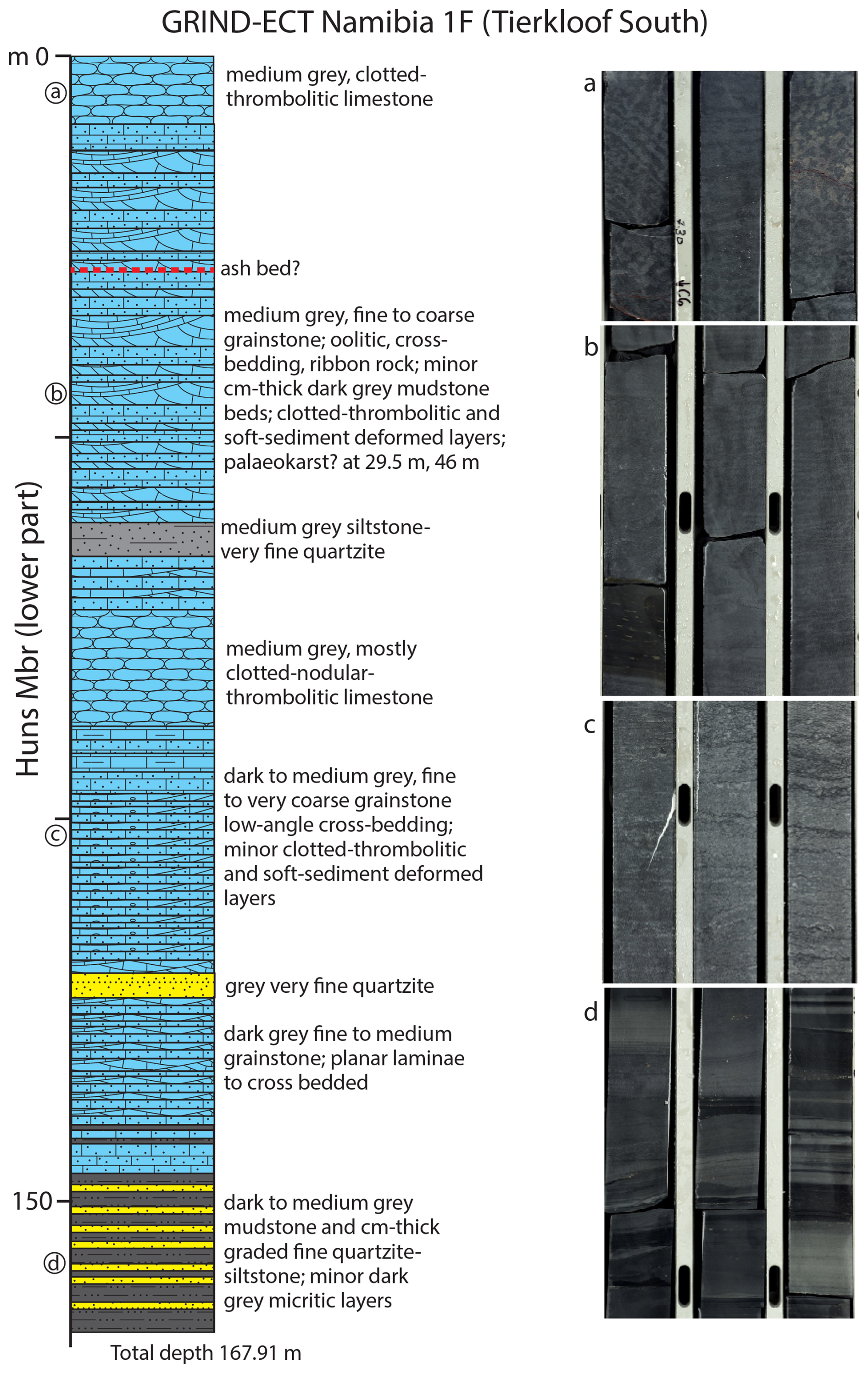
Figure 7Summary sections of GRIND-ECT Core 1F (Tierkloof South); circled letters to the left of the column show the stratigraphic position of the core images. Cores are 63.5 mm in diameter (HQ). (a) Thrombolite. (b) Ribbon rock and thin-bedded fine-grained packstone–wackestone; note pyritic black shale in the lower left of the first core barrel. (c) Thin-bedded packstone–wackestone marked by wavy–crinkly laminae and wispy dark micrite partings. (d) Rippled and planar laminated , sharp-based, centimetre-thick, graded quartzite interbedded with medium- to dark-grey mudstone.
Core 1B – Swartpunt South (Fig. 8). This core is 518.15 m in length and descends through the carbonate rocks of the lower part of the Spitskop Member, the fine-grained siliciclastic rocks of the Feldschuhorn Member, and the limestones of the upper and middle Huns Member. See Core 1D (Swartpunt) for a summary description of the Spitskop Member. The Feldschuhorn Member is mostly green-grey, millimetre- to centimetre-scale bedded fine sandstone and siltstone marked by fine planar laminae, massive intervals, and soft-sediment deformation. Minor interlayered limestones are pastel coloured and range from laminated fine grainstone to micrite, with the latter exhibiting travertine or tufa textures. The Huns Member is dominated by decimetre- to metre-thick intervals of interbedded fine- to very-coarse-grained peloidal–ooidal–intraclastic grainstone–packstone–wackestone, thrombolitic–clotted-textured limestone, planar–wavy–crinkly laminae (microbialite), ribbon rock, and dark-grey mudstone–micrite. In the outcrop, these facies define variably developed depositional cycles. Combined, the facies characteristics indicate deposition in outer- to inner-ramp and possibly shoreface–shoreline settings.
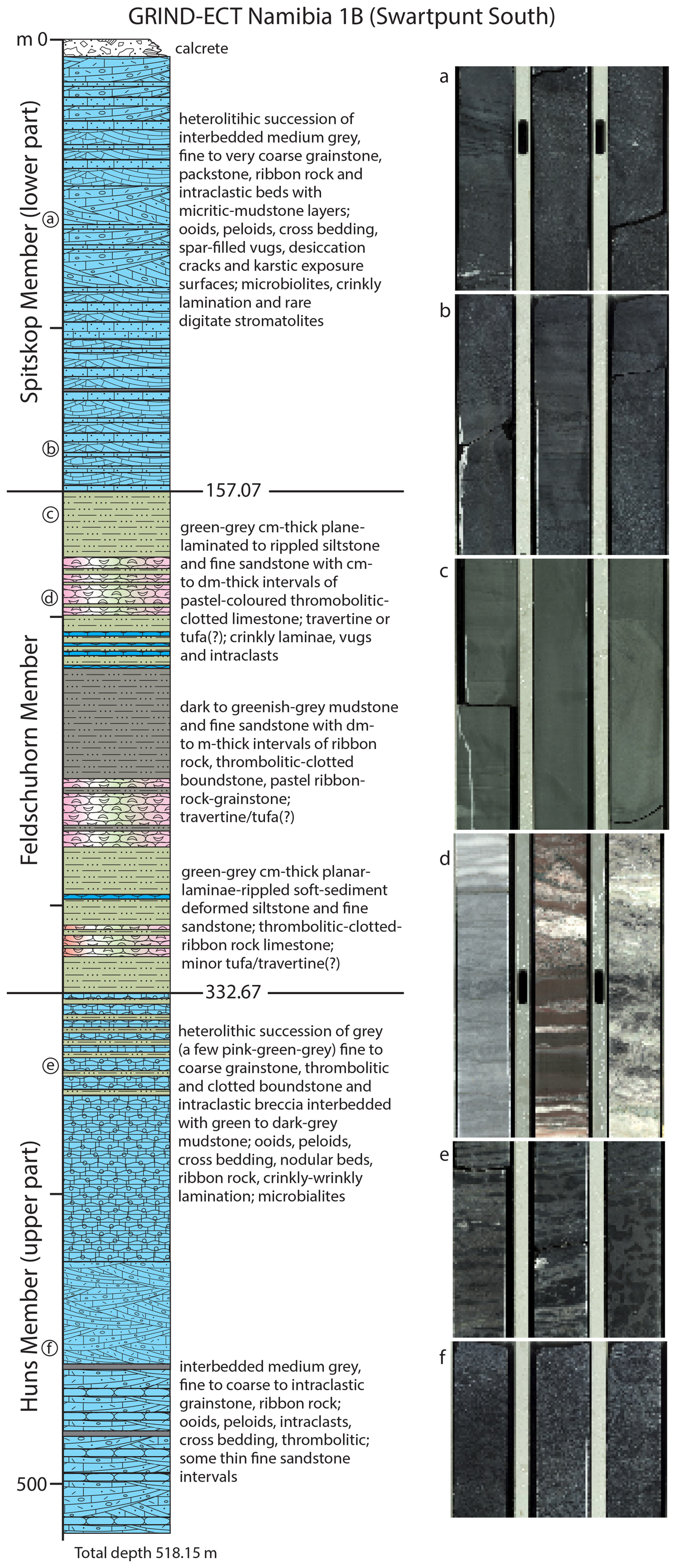
Figure 8Summary section of GRIND-ECT Core 1B (Swartpunt South); circled letters to the left of the column show the stratigraphic position of the core images. Cores are 63.5 mm in diameter (HQ). (a, b) Grey, medium- to coarse-grained, peloidal–ooidal–intraclastic grainstone–packstone arranged in metre-thick beds; beds are commonly sharp-based, graded, and cross-bedded. (c) Green-grey siltstone to very fine sandstone marked by massive, soft-sediment deformed and planar-laminated textures, locally with centimetre-scale ripples and pinstripe–lenticular bedding. (d) Variegated and pastel-coloured micritic limestone, possible tufa or travertine deposits. (e) Medium- to dark-grey mottled and clotted textured thrombolite interbedded with dark micritic to fine intraclastic grainstone–packstone–wackestone. (f) Coarse- to very-coarse-grained intraclastic–peloidal–ooidal grainstone–packstone in decimetre- to metre-thick beds; many beds are graded and cross-bedded.
Core 1D – Swartpunt (Fig. 9). This core is 272.48 m in length and captures the carbonate rocks and fossil-rich strata of the Spitskop Member, including tuffs that may help improve age constraints on the Ediacaran–Cambrian boundary. The facies association consists of a heterolithic suite of carbonate rock textures representative of deeper outer-ramp to inner-ramp and shoreface settings. Characteristic features include centimetre- to decimetre-scale cross-bedded grainstone–packstone; in places, oolitic, ribbon rock; intraclastic grainstone breccia; centimetre-scale interlayering of planar to wavy to crinkly–wrinkly laminae (“microbialite”); thrombolite and stromatolite layers; and, particularly in Core 1H (Orange River), minor intervals of rhythmite and laminate (both as carbonate and siliciclastic facies). Colours of all lithofacies range from light to dark grey and, in many places, display clotted–mottled appearances. Punctuating the carbonate facies are intervals of decimetre- to metre-thick green-grey siltstone and fine sandstone. These are commonly massive in appearance with intervals of faint parallel laminae and millimetre- to centimetre-scale ripples, as well as much soft-sediment deformation. Numerous, green-grey siliceous volcanic tuffs are present.
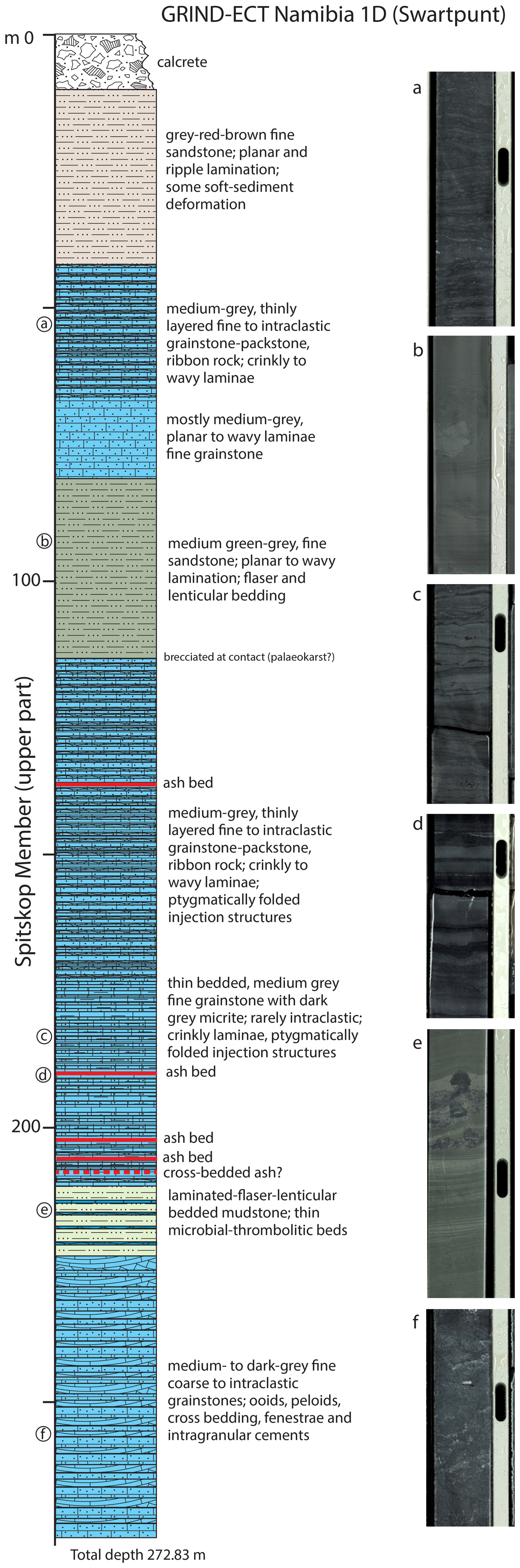
Figure 9Summary section of GRIND-ECT Core 1D (Swartpunt); circled letters to the left of the column show the stratigraphic position of the core images. Cores are 63.5 mm in diameter (HQ). (a) Thin-bedded packstone–wackestone and fine-grained intraclastic beds all with wavy–planar–crinkly laminae. (b) Grey-green fine-grained sandstone–siltstone marked by planar laminae, flaser–lenticular bedding, and soft-sediment deformation features. (c) Thin-bedded fine-grained grainstone–wackestone with abundant dark-grey micritic partings. (d) Thin-bedded, graded fine-grained grainstone with ribbon rock; central core has a green-grey siliceous tuff. (e) Planar–pinstripe–flaser bedded green-grey siltstone containing thin thrombolitic–digitate stromatolite layers. (f) Medium- to coarse-grained peloidal–ooidal–intraclastic wackestone–grainstone interbedded with mottled-textured (thrombolitic–microbialite?) grainstone, thin intraclastic breccia beds, and cross-bedded to low-angle-, planar-laminated grainstone.
Core 1H – Orange River (Fig. 10). This core is 515.04 m in length. It recovers the youngest strata of the Kuibis–Schwarzrand succession, predominantly in the Spitskop Member (Nelson et al., 2022). It overlaps considerably with Core 1D (Swartpunt), although a more precise correlation will be determined via paired C-isotope chemostratigraphy and geochronology. The Spitskop Member equivalent features centimetre- to decimetre-scale oolitic cross-bedded grainstone–packstone, intraclastic grainstone breccia, centimetre-scale interlayering of microbialite and stromatolite with thin intervals of rhythmite. See Core 1D for a summary description of the Spitskop Member. These facies grade into green-grey millimetre- to centimetre-scale bedded fine-grained sandstone and siltstone marked by finely planar laminae and soft-sediment deformation, which could correlate with the Feldschuhorn Member (Nelson et al., 2022; see Core 1B for description). The lowermost stratigraphy is dominated by intraclastic breccias and cross-bedded peloidal–ooidal grainstone–packstones with wavy–crinkly microbialite laminae and occasional thin intervals of siltstone, which might be correlative to the upper Huns Member (Nelson et al., 2022; see Core 1B for description).
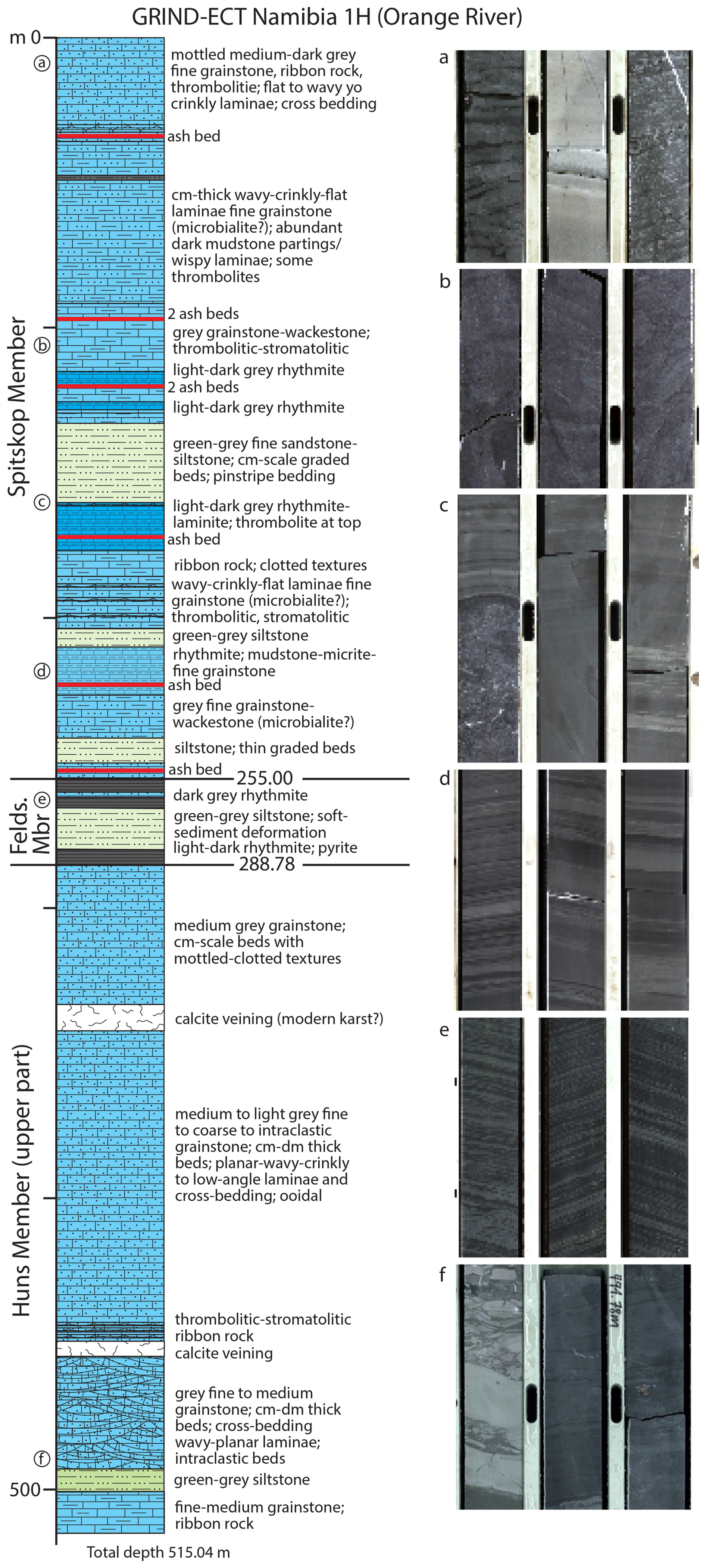
Figure 10Summary section of GRIND-ECT Core 1H (Orange River); circled letters to the left of the column show the stratigraphic position of the core images. Cores are 63.5 mm in diameter (HQ core). (a) Ribbon rock, cross-bedded grainstone and thrombolite. (b) Nodular bedding, intraclastic packstone and flake–breccia microbialite (likely stromatolitic). (c) Contact between underlying brecciated thrombolite and overlying green-grey planar- to massive- to ripple-laminated and pinstripe-bedded siltstone. (d) Light- to dark-grey carbonate–marl rhythmite interbedded with centimetre-thick, sharp-based graded and rippled beds. (e) Light- to dark-grey siliciclastic rhythmite with centimetre-scale rippled beds. (f) Intraclastic breccia and cross-bedded grainstone–packstone.
The Corumbá Group records deposition on a marine carbonate platform that fringed the southeast margin of the Amazon Craton and consists of the Cadiueus, Cerradinho, Bocaina, Tamengo, and Guaicurus formations (Almeida and Hasui, 1984; Fig. 11). The drilling targets of GRIND-ECT in Brazil are the shale and carbonaceous limestone of the latter three formations, which contain the best ECT fossil record in South America (Warren et al., 2012; Pacheco et al., 2015). The Tamengo Formation has Corumbella werneri, Cloudina luceanoi, and conulariids (Walde et al., 2015). The Guaicurus Formation has vendotaenid fossils, including Eoholynia corumbensis (Boggiani et al., 2010). These rocks have not experienced metamorphism or severe organic matter maturation (Spangenberg et al., 2014) and, combined with C-isotope profiles that are interpreted as the rising trend of the Shuram excursion (from −3 ‰ to +5 ‰ in δ13Ccarb; Boggiani et al., 2010; Spangenberg et al., 2014), define a relatively continuous record across the Ediacaran–Cambrian boundary. Tamengo Formation tuffs yielded a U–Pb zircon age of 543 ± 3 Ma (Babinski et al., 2008), and multiple other tuffs within that unit and the Guaicurus Formation have been sampled. The target rocks are the Bocaina, Tamengo, and Guaicurus formations at Sobramil Harbor and Laginha Mine. This region is a mining district, making the logistics simple: local drilling contractors had operational expertise; electricity and water were accessible; and core handling, core-splitting, and preliminary description were done on site. In addition, the geology is structurally simple, which ensured that the drilling targets were recovered.
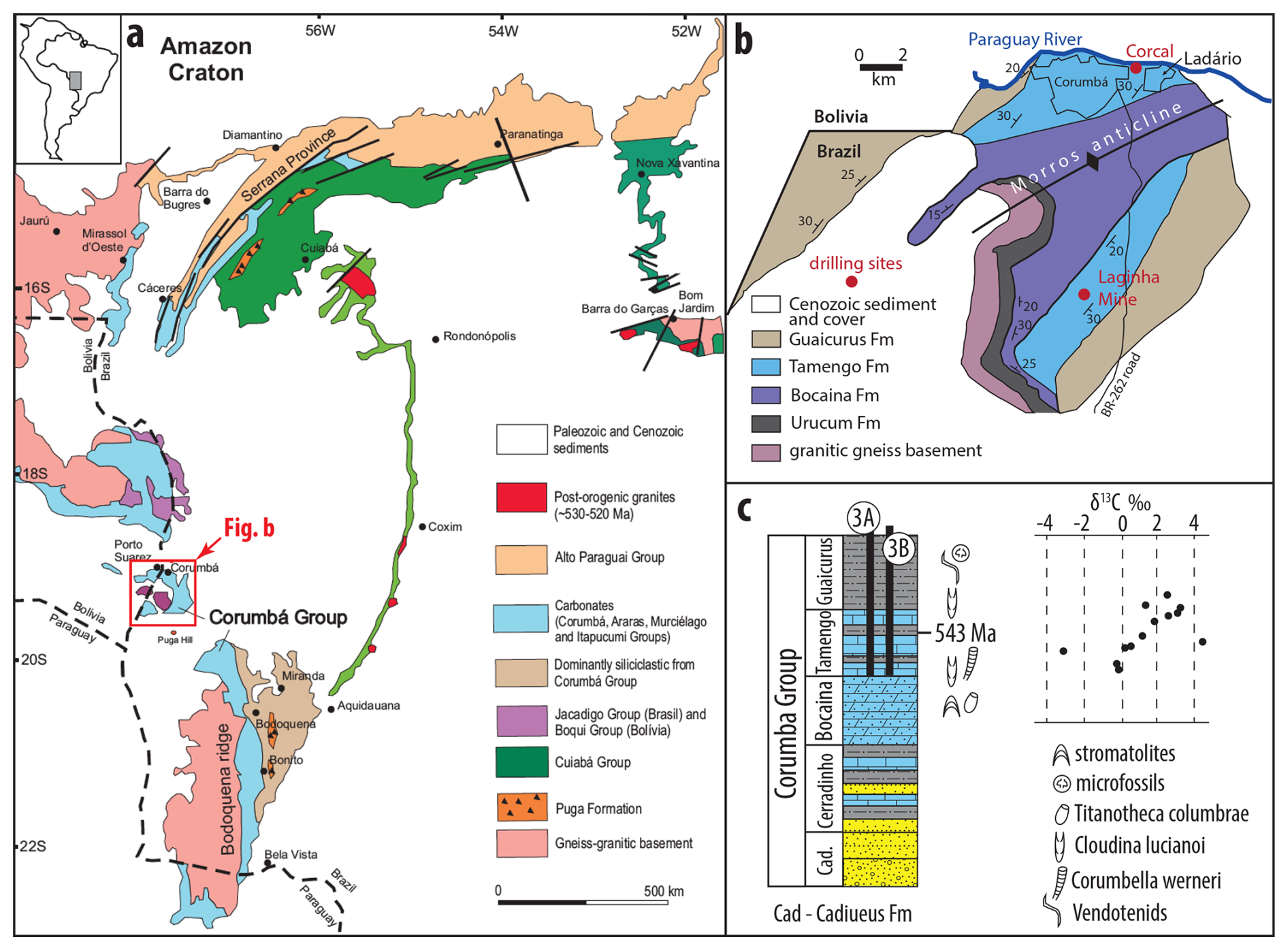
Figure 11(a) Simplified geologic map of the South Paraguay Belt and Urucum district in Brazil (modified from Freitas et al., 2021). (b) Geologic map showing drill site locations across the Morros Anticline in the Mato Grosso do Sul region. (c) Chemostratigraphic trends for the Tamengo and Guaicurus formations at Sobramil Harbor and Laginha Mine near Corumbá (adapted from Boggiani et al., 2010; Spangenberg et al., 2014).
5.1 The Corumbá Group
The Paraguay Belt in midwestern Brazil is a Neoproterozoic to early Cambrian fold–thrust belt formed during the collision of the Amazon Craton with the Paranapanema and São Francisco cratons in the final amalgamation of western Gondwana (Trompette, 1994). The southern Paraguay Belt includes the Cryogenian Jacadigo Group (Freitas et al., 2011), the Ediacaran Corumbá Group (Almeida, 1965; Gaucher et al., 2003; Misi et al., 2007; Boggiani et al., 2010), metamorphic rocks (Campanha et al., 2011), and post-collisional granitoids (Manzano et al., 2008; Godoy et al., 2010). The Corumbá Group marks the final sedimentation in the southern Paraguay Belt.
The Corumbá Group comprises a mixed siliciclastic–carbonate succession that includes six formations: Cadiueus, Cerradinho, Morraria do Sul, Bocaina, Tamengo, and Guaicurus (Almeida, 1965; Boggiani, 1998; Gaucher et al., 2003; Fernandes et al., 2025). The lowermost units, the Cadiueus and Cerradinho formations, are composed of glacial-outwash conglomerates and arkosic sandstones linked to the end-Cryogenian Marinoan glaciation (Hiatt et al., 2020). Overlying these, the Morraria do Sul Formation is a post-glacial cap carbonate characterized by tubestone–microbialite sequences (Romero et al., 2016; Fernandes et al., 2025). A major stratigraphic hiatus (ca. 50 Ma) separates these three lower formations from the overlying units. The Bocaina Formation is characterized by a dolomite–phosphorite–shale succession, indicative of a rimmed carbonate shelf with microbialites and a rich microfossil assemblage (Morais et al., 2021; Hippertt et al., 2023). The boundary between the Bocaina and Tamengo formations is marked by an erosive surface, above which polymictic breccias and gravity flow deposits indicate a major regression (Fernandes et al., 2022). The Tamengo Formation consists of storm-dominated carbonate ramp deposits, including limestones, shales, macrofossils, macroalgae, microfossils, and bilaterian ichnofossils (Pacheco et al., 2015; Walde et al., 2015; Adôrno et al., 2017; Becker-Kerber et al., 2017; Diniz et al., 2021; Afonso et al., 2024). The Guaicurus Formation, the uppermost unit of the Corumbá Group, consists primarily of siltstones and shales. It represents the final transgressive phase of the succession and likely extends into the Early Cambrian (Walde et al., 2015; Fazio et al., 2019).
The age of the Bocaina Formation is defined by U–Pb zircon dating, with a key age of 555.18 ± 0.30 Ma obtained from an ash bed in the Porto Morrinhos section (Parry et al., 2017). More recently, a U–Pb date of 571 ± 9 Ma from dolomite in the Serra da Bodoquena area was reported (Morais et al., 2024). In the overlying Tamengo Formation, two ash beds from the Corcal section yielded U–Pb zircon ages of 542.37 ± 0.28 Ma and 541.85 ± 0.75 Ma (Parry et al., 2017), placing it firmly within the terminal Ediacaran. These dates align with the occurrence of Cloudina in the formation.
Carbon isotope values in the Bocaina Formation typically exhibit a relatively stable or slightly positive δ13C trend, reflecting a marine carbonate shelf environment with microbial activity and a diverse microfossil assemblage (Morais et al., 2021; Hippertt et al., 2023). In contrast, the Tamengo Formation shows more pronounced fluctuations in δ13C, which is consistent with a storm-dominated carbonate ramp setting (Oliveira et al., 2019; Amorim et al., 2020). The carbon isotope data in this unit often display a more dynamic range, likely reflecting changes in sea level, water circulation, and biological productivity associated with storm events and transgressive–regressive cycles. The continuous rock record obtained by GRIND-ECT cores offer a means of creating a more finely resolved C-isotope chemostratigraphy in the context of a high-resolution age model.
5.2 GRIND-ECT cores 3A and 3B
The two cores through the Corumbá Group were characterized in detail in the field and at BGR, where the cores were split and scanned (Fig. 12). All the stratigraphic and sample data are stored in ICDP's DIS system, and the core scans and analytical data are hosted on ICDP's website for access by GRIND-ECT researchers. Once the moratorium period ends (May 2026), these data will become open access to researchers worldwide.
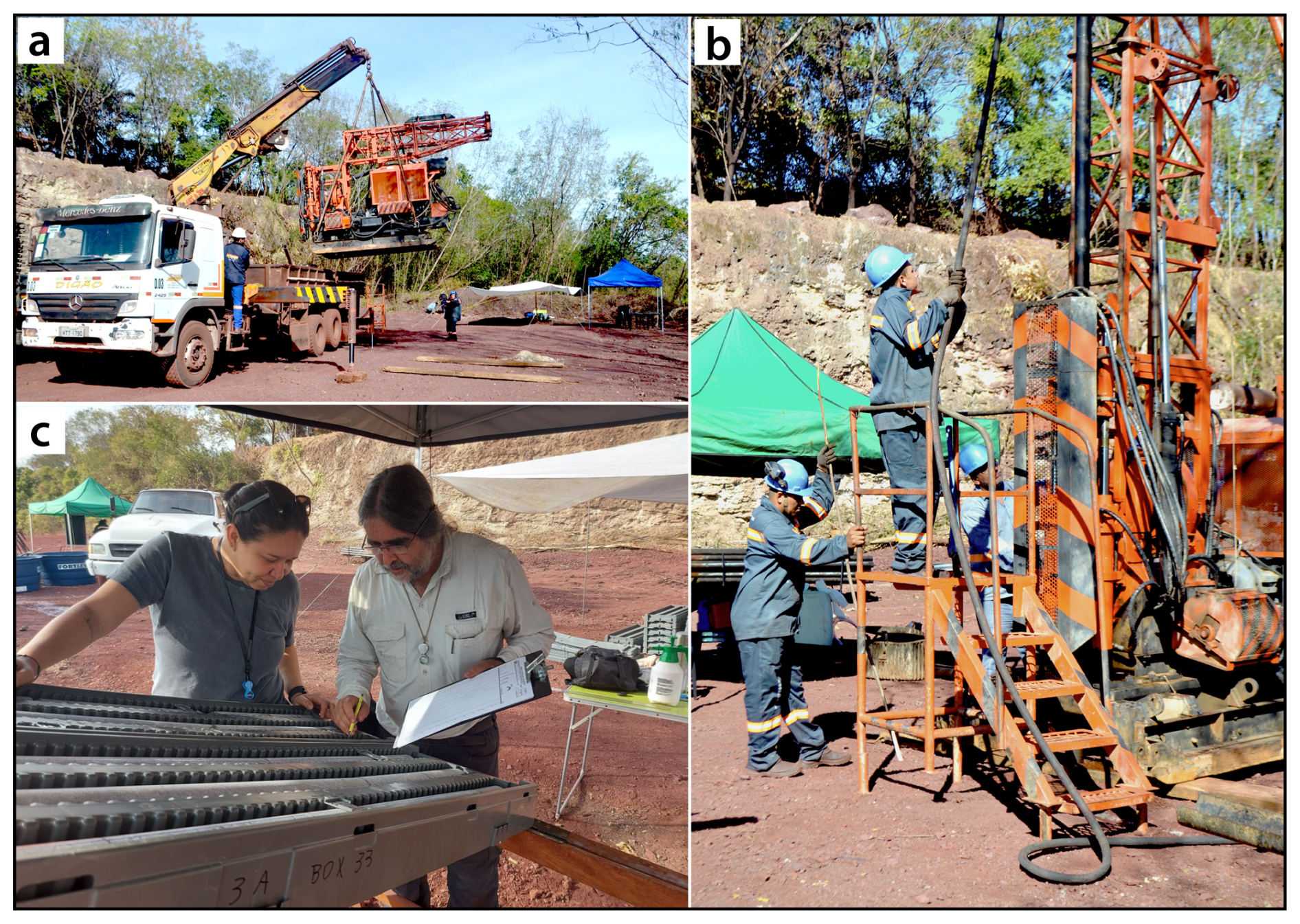
Figure 12Photos of drilling the GRIND-ECT cores in Brazil. (a) Arrival of the drilling rig at the Sobramil site. (b) Anchoring the drilling rig at the Sobramil site. (c) Kamilla Amorim and Paulo Boggiani working on the description of the dolostone of the Bocaina Formation.
The oldest strata are represented by core 3A (−19.00, −57.62°), drilled at Porto Sobramil (formerly Saladeiro Mine) in Corumbá. This core includes limestones and shales from the Tamengo Formation, extending down to a depth of 55.24 m. At this point, there is a distinct boundary with the dolomites of the Bocaina Formation (Fig. 11), which continue to the end of the core at 182.95 m. Core 3B (−19.02, −57.68°) was drilled at the Corcal Mine, located about 7 km west of core 3A, also in the Corumbá Group (Fig. 11). The upper 114.58 m of this core consists of limestones and shales of the Tamengo Formation, while the lower 8.45 m is composed of dolomites of the Bocaina Formation. These members also contain interbedded tuffs, key targets for U–Pb zircon dating.
Core 3A – Sobramil (Fig. 13). This core is 183.1 m long and primarily recovers dolomudstones and dolostone flat-pebble and tepee breccias, along with rare stromatolite clasts in the lower 30 m of core 3A. Between 166 and 145 m depth, abundant breccia layers with intraclasts of oncolites, grainstones, and some phosphorites are present (Fig. 13e). Above this, microbialites dominate, including oncoids (up to 20 cm in diameter) and occasional columnar stromatolites (Fig. 13c, d). From 72 to 55.5 m, the core contains mat stromatolites interbedded with plane-parallel-bedded dolograinstones, which transition into flat-pebble breccias. This breccia is truncated by an erosive surface at the Bocaina–Tamengo contact (Fig. 13b). The upper 50 m of core 3A consists of limestones and shales from the Tamengo Formation, showing a fining-upwards trend (Fig. 13a). The black shales exhibit plane-parallel lamination, with occasional soft-sediment deformation structures. These shales are composed of three main layers, locally interbedded with thin limestone layers. The limestones are mainly plane-parallel stratified grainstones, with some low-angle truncation and wavy lamination. Additionally, thin layers of mudstones and intraclast breccias are interbedded with the grainstones.
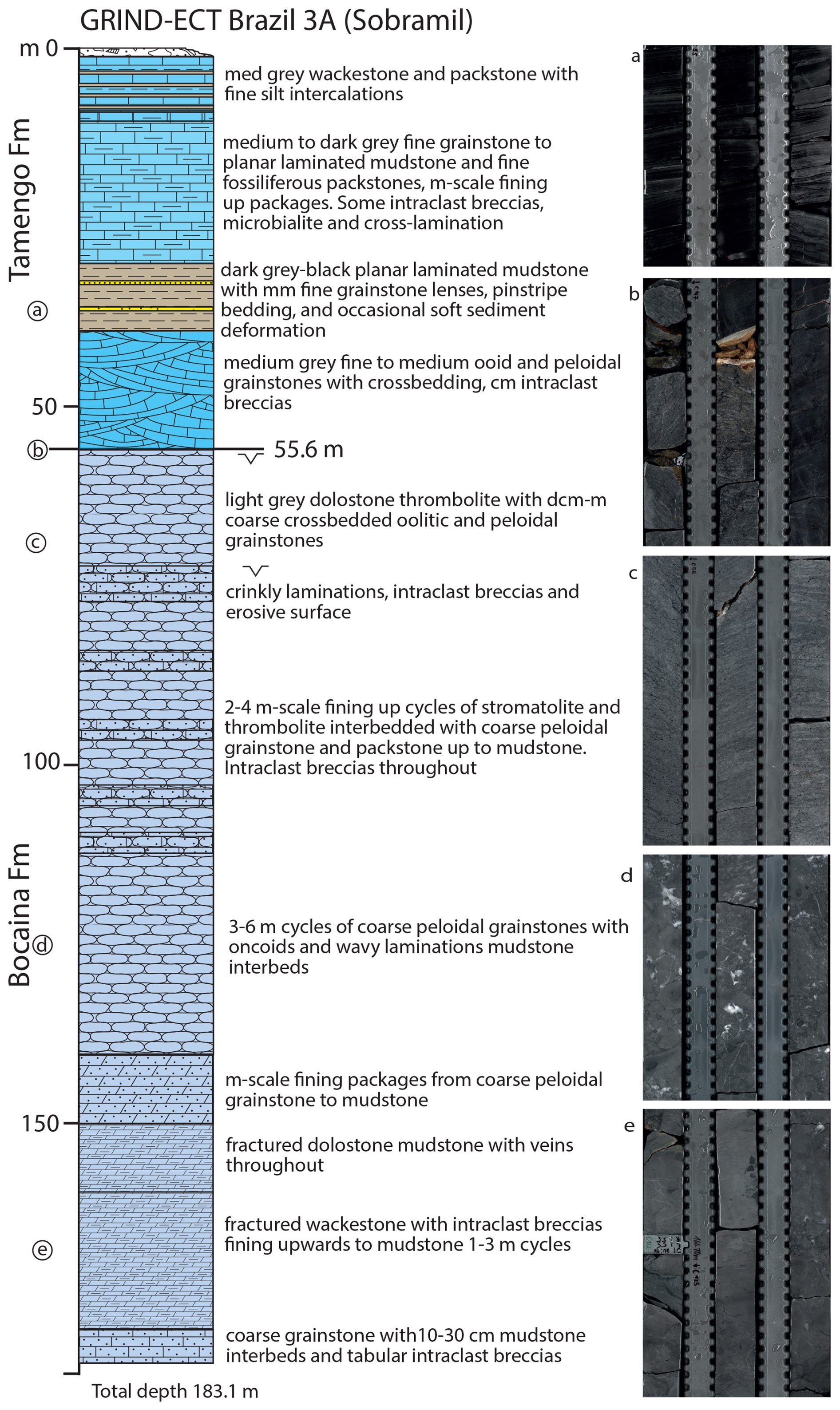
Figure 13Summary section of GRIND-ECT Core 3A (Sobramil Harbor); circled letters to the left of the column show the stratigraphic position of the core images. The cores are 63.5 mm in diameter (HQ). (a) Dark-grey to black planar-laminated mudstone with millimetre-thick grainstone lenses and pinstripe bedding. (b) Boundary from dolomitic thrombolite in Bocaina Fm to the overlying oolitic limestone–grainstone of Tamengo Fm. (c) Crinkly laminations of stromatolite with intraclast breccias. (d) Coarse-grained peloidal grainstones with oncoids and wavy laminated mudstone interbeds. (e) Wackestone with intraclast breccia fining upward to mudstone.
The Bocaina Formation in core 3A primarily consists of microbialites, oncoids, intraclast breccias, and grainstones. Collectively, these facies indicate a moderate- to high-energy, wave-agitated setting on a storm-dominated carbonate platform. The intercalation of high- and low-energy facies reflects storm- and fair-weather sedimentation pulses, respectively. The black shales of the Tamengo Formation in cores 3A were deposited in a low-energy setting that promoted the high accumulation of organic matter. Grainstones with wavy cross-bedding and low-angle truncation indicate occasional sediment reworking by strong flows. It is interpreted that the erosion of the upper Bocaina Fm represents a lowstand and a change upsection in carbonate platform morphology from a rimmed shelf to a distally steepened ramp (Fernandes et al., 2025).
Core 3B – Corcal (Fig. 14). This core is 122.6 m in length. The lowest segment of core 3B consists of coarse dolograinstones and stromatolites down to 114.6 m, marking the erosive surface at the Bocaina-Tamengo contact (Fig. 14d). Above this surface, the succession resembles the upper section of core 3A, with abundant black shales interbedded with grainstones, exhibiting fining-upward trends up to 60 m depth. Within this section, carbonate concretions up to 7 cm in diameter and millimetre-sized euhedral pyrites are found in the black shale. From 60 to 3.5 m, shallowing-upward cycles of ooid grainstones with thin layers of black shales occur. The grainstones display swaley cross-stratification, wavy lamination, and low-angle truncation (Fig. 14a–c). The top 3.5 m consists of weathered siltstones, which are interpreted to belong to the Guaicurus Formation. Similarly to core 3A, this core features microbialites, intraclast breccias, and grainstones in the Bocaina Formation, transitioning to mudstones with intercalated fine grainstones of the Tamengo Formation and ending with weathered siltstones of the Guaicurus Formation. These facies are interpreted as a rimmed shelf to distally steepened carbonate ramp, influenced by storms throughout (as discussed in the previous section).
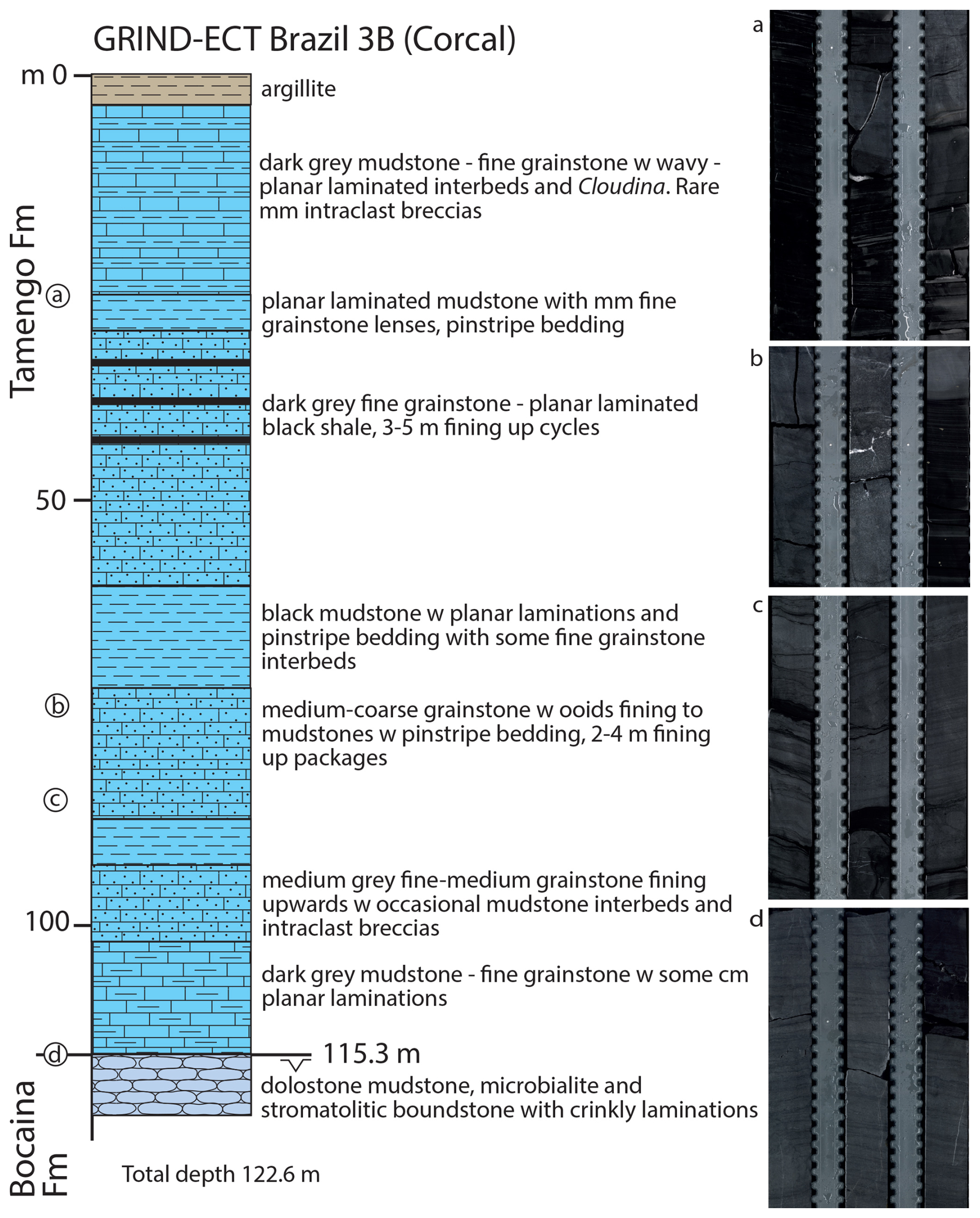
Figure 14Summary section of GRIND-ECT Core 3B (Corcal Mine); circled letters to the left of the column show the stratigraphic position of the core images. Cores are 63.5 mm in diameter (HQ). (a) Planar-laminated mudstone with millimetre grainstone lenses. (b–c) Oolitic grainstone fining to mudstones with wavy and pinstripe bedding. (d) Boundary from dolomitic microbialite in Bocaina Fm to mudstone–grainstone with planar laminations of Tamengo Fm.
The GRIND research teams have entered the phase of generating, sharing, and publishing novel datasets that are shaping our understanding of the ECT. Three staggered sampling parties have collected 2823 samples from Namibian cores and 267 samples from Brazilian cores to date. These samples are being analysed for geobiology, palaeomagnetism, geochronology, and geochemistry (including major and trace elements, as well as traditional and non-traditional isotopes). Many of the samples are being used for multiple types of analysis, which takes time, specifically to organize the logistics and sharing of sample sets. Publications to date include papers utilizing palaeomagnetic and geochronological datasets. Gong et al. (2025) present new magnetic susceptibility data from the lower Schwarzrand Sub-group and use spectral analysis to identify orbital cycles responsible for repeating depositional sequences. By matching the wavelengths of these cycles to their expected periodicities, they determined sedimentation rates across the stratigraphy. The updated age-depth model provides more precise temporal constraints on the appearance of complex trace fossils, refining our understanding of the earliest major radiation of bilaterian metazoans and improving the chronostratigraphy of the terminal Ediacaran Period. Current age models indicate exceptionally high sedimentation rates in the Schwarzrand Sub-group, resulting in an expanded Ediacaran–Cambrian succession that likely preserves a higher-resolution record of evolutionary change over this interval than is available elsewhere globally (Nelson et al., 2022; Gong et al., 2025).
Pescarini et al. (2025) identified three magnetic components in the GRIND-ECT Namibia cores: C1 (modern magnetization), C2 (Paleozoic demagnetization), and C3 (primary detrital origin). Component C3 records an unstable geomagnetic field at 540 Ma, the youngest evidence of such instability in the Ediacaran and the first from the Kalahari Craton. These data provide new support for a largely unstable geomagnetic field during this period. These early findings are part of an ongoing series of discoveries, with much more data expected in the future, marking the first phases of scientific progress in this field.
Bowyer et al. (2025) analysed multiple silicified volcanic tuff interbeds from GRIND drill cores and neighbouring outcrops to resolve uncertainties about whether U–Pb ages reflect reworked zircons or true depositional ages and whether there might be undetected stratigraphic repetition of units. New U–Pb data, interpreted within an updated tectonic framework, have been used to suggest a cryptic décollement in the Spitskop Member, which has caused stratigraphic and U–Pb age repetition. These data have fuelled an active debate, with future papers expected to focus on further new U–Pb age analyses from volcanic ash layers.
Our current focus as a collaborative research team is to compile all the measured carbon isotope analyses across the entire stratigraphy to establish a chemostratigraphic framework for an age model. These results will be published as a stand-alone paper but will subsequently be integrated with dated ash layers to address key questions about the timing, duration, and causal mechanisms behind the large-amplitude carbon isotope excursions observed in Ediacaran and early Cambrian strata. Together, our efforts have made significant progress toward achieving our initial scientific objectives. This work will enable us to achieve a high temporal resolution, essential for addressing fundamental questions about the lead-up to and genesis of the Cambrian Explosion. The age model will help us investigate the timing and rates of the appearance, expansion, and extinction of the Ediacara biota. As additional geochemical data are processed, this temporal framework will allow for more accurate correlations and provide insights into the global and regional patterns of marine oxygenation. It will also enable us to assess how these patterns relate to other geochemical trends and explore the possibility of a Neoproterozoic oxygenation event.
The Namibian and Brazilian phases of GRIND-ECT realized the research vision outlined by the international Earth science community at the 2014 GRIND Workshop: to create a worldwide core archive of the best-developed sedimentary successions containing the key biogeochemical episodes of the Neoproterozoic Era. Six cores totalling 2379 m recovered a nearly complete section of the late Ediacaran–earliest Cambrian Kuibis and Schwarzrand sub-groups of the Nama Group in southern Namibia. An additional two cores totalling 306 m recovered the Guaicurus, Tamengo, and Bocaina formations of the Corumbá Group in Brazil. Collectively, these cores record the evolutionary advent and decline of the Ediacaran fauna and the rise and expansion of animals. The quality and completeness of the cores will enable us to thoroughly integrate sedimentology with novel isotope and geochemical analyses to inform on the causes and consequences of the changing redox states that marked the oceanic realm during those evolutionary milestones. Interlayered volcanic tuffs will underpin the development of a finely resolved age–depth model and much needed constraints for assessing evolutionary turnover rates during and following the rise of animals. While the project was delayed by COVID-19, which halted drilling in 2019 and delayed further fieldwork until 2022, all initial objectives were achieved, and the project remained within budget. Data collection and analysis are ongoing, and work is still in progress to fully achieve the project's goals. In effect, GRIND-ECT is delivering the data to deepen understanding of the genesis of the Cambrian Explosion. The cores housed at the BGR facility in Berlin–Spandau, Germany, will form a legacy resource for decades to come for researching the Ediacaran–Cambrian transition and its impact on Earth's surface environments.
All the data can be found here: https://doi.org/10.5880/ICDP.5064.001 (Rose et al., 2026).
The project was conceived and developed by SK, FM, AP, CR, RT, and MZ. Financial support for the drilling operations was secured by SK, FM, AP, CR, and RT. SK, MM, CR, AN, and AP conducted the logistics and fieldwork for the drilling campaign in Namibia, while MM and RT led the drilling operations in Brazil. Overall supervision of the GRIND-ECT project was provided by SK, FM, AP, CR, and RT. Data curation was carried out by MM and CR. AP and CR prepared the original paper, with contributions from all of the co-authors. Data, stratigraphic sections, and maps were produced by CR and AP.
The contact author has declared that none of the authors has any competing interests.
Publisher's note: Copernicus Publications remains neutral with regard to jurisdictional claims made in the text, published maps, institutional affiliations, or any other geographical representation in this paper. The authors bear the ultimate responsibility for providing appropriate place names. Views expressed in the text are those of the authors and do not necessarily reflect the views of the publisher.
Thanks are extended to Iona Baillie, Marjorie Cantine, Petrus Petrus, and Wilhem Tomas and all of the GSN staff for their hard work at the Namibian drill sites and for the extended time working in the BGR core storage facility. Thanks are extended to Kamilla Amorim and Jhon Afonso for the sedimentary logging expertise on site in Brazil, as well as to Juliana Leme and Paulo Boggiano. We thank ICDP for the financial and logistical support, from the initial workshop through to fieldwork. We are grateful to Lothar Gessert for the land access in Namibia and to Sociedade Brasileira de Mineração Ltda and Corcal Corumba Calcario Ltda for the mine access in Brazil. National funding agencies contributed to drilling and sample party costs, including FAPESP Research (Brazil), NERC Discovery Science (UK), NSF Frontier Research in Earth Sciences (USA), and DFG (Germany) grants.
GRIND-ECT was funded by the International Continental Scientific Drilling Program (ICDP), the São Paulo Research Foundation (FAPESP, grant no. 16/06114-6), the UK Natural Environment Research Council (NERC, grant no. NE/T0008458/1), the German Research Foundation (DFG, grant nos. 497319897 and 497339722) and the US National Science Foundation (NSF, grant no. 2021064).
This paper was edited by Will Sager and reviewed by Simon Darroch and Christoph Heubeck.
Adôrno, R. R., do Carmo, D. A., Germs, G., Walde, D. H. G., Denezine, M., Boggiani, P. C., Sousa e Silva, S. C., Vasconcelos, J. R., Tobias, T. C., Guimarães, E. M., Vieira, L. C., Figueiredo, M. F., Moraes, R., Caminha, S. A., Suarez, P. A. Z., Rodrigues, C. V., Caixeta, G. M., Pinho, D., Schneider, G., and Muyamba, R.: Cloudina lucianoi (Beurlen & Sommer, 1957), Tamengo Formation, Ediacaran, Brazil: Taxonomy, analysis of stratigraphic distribution and biostratigraphy, Precambrian Res., 301, 19–35, https://doi.org/10.1016/j.precamres.2017.08.023, 2017.
Afonso, J. W. L., Pereira, L. G., de Faria, B. A., Romero, G. R., Amorim, K. B., Basso, J. M. L., and Trindade, R. I. F.: Stratigraphical and sedimentological controls on the distribution of Cloudina bioclastic accumulations in the terminal Ediacaran Tamengo Formation (Corumbá Group), Brazil, Sediment. Geol., 463, 106580, https://doi.org/10.1016/j.sedgeo.2024.106580, 2024.
Almeida, F. F. M.: Geologia da Serra da Bodoquena (Mato Grosso), DNPM, Departamento Nacional da Produção Mineral, 1965.
Amorim, K. B., Afonso, J. W. L., Leme, J. de M., Diniz, C. Q. C., Rivera, L. C. M., Gómez-Gutiérrez, J. C., Boggiani, P. C., and Trindade, R. I. F.: Sedimentary facies, fossil distribution and depositional setting of the late Ediacaran Tamengo Formation (Brazil), Sedimentology, 67, 3422–3450, https://doi.org/10.1111/sed.12967, 2020.
Babinski, M., Boggiani, P. C., Fanning, C. M., Fairchild, T. R., Simon, C. M., and Sial, A. N.: U–Pb SHRIMP geochronology and isotope chemostratigraphy (C, O, Sr) of the Tamengo Formation, southern Paraguay Belt, Brazil, in: VI South American Symposium on Isotope Geology, Book of Abstracts, INGEIS – Instituto de Geocronología y Geología Isotópica, p. 160, https://repositorio.usp.br/item/001701908 (last access: 20 August 2026), 2008.
Becker-Kerber, B., Pacheco, M. L. A. F., Rudnitzki, I. D., Galante, D., Rodrigues, F., and Leme, J. D. M.: Ecological interactions in Cloudina from the Ediacaran of Brazil: implications for the rise of animal biomineralization, Sci. Rep., 7, 5482, https://doi.org/10.1038/s41598-017-05753-8, 2017.
Boggiani, P. C.: Análise Estratigráfica da Bacia Corumbá (Neoproterozóico) – Mato Grosso do Sul, PhD Thesis, Universidade de São Paulo, São Paulo, https://doi.org/10.11606/T.44.1998.tde-14082013-111741, 1998.
Boggiani, P. C., Gaucher, C., Sial, A. N., Fairchild, T. R., Babinski, M., Simon, C. M., and Ferreira, V. P.: Chemostratigraphy of the Tamengo Formation (Corumbá Group, Brazil): calibration of the Ediacaran C-isotope curve, Precamb. Res., 182, 382–401, https://doi.org/10.1016/j.precamres.2010.06.003, 2010.
Bowring, S. A., Grotzinger, J. P., Condon, D. J., Ramezani, J., Newall, M. J., and Allen, P. A.: Geochronologic constraints on the chronostratigraphic framework of the Neoproterozoic Huqf Supergroup, Sultanate of Oman, Am. J. Sci., 307, 1097–1145, 2007.
Bowyer, F. T., Zhuravlev, A. Y., Wood, R., Shields, G. A., Zhou, Y., Curtis, A., Poulton, S. W., Condon, D. J., Yang, C., and Zhu, M.: Calibrating the temporal and spatial dynamics of the Ediacaran–Cambrian radiation of animals, Earth-Sci. Rev., 225, 103913, https://doi.org/10.1016/j.earscirev.2021.103913, 2022.
Bowyer, F. T., Messori, F., Wood, R., Linnemann, U., Rojo-Pérez, E., Zieger-Hofmann, M., Zieger, J., Ndeunyema, J., Shipanga, M., Mataboge, B., Condon, D., Rose, C. V., Uahengo, C.-I., Gaynor, S. P., Müller, I. A., Geyer, G., Vennemann, T., Davies, J. H. F. L., and Ovtcharova, M.: Foundational uncertainties in terminal Ediacaran chronostratigraphy revealed by high-precision zircon U–Pb geochronology of the Nama Group, Namibia, Earth-Sci. Rev., 268, 105169, https://doi.org/10.1016/j.earscirev.2025.105169, 2025.
Brasier, M. D., Prave, A. R., Van Wiemeersch, B., and Compston, W.: Integrated chemo- and biostratigraphic calibration of early animal evolution: Neoproterozoic–early Cambrian of southwest Mongolia, Geol. Mag., 133, 445–485, https://doi.org/10.1017/S0016756800007603, 1996.
Brocks, J., Jarrett, A., Sirantoine, E., Hallmann, C., Hoshino, Y., and Liyanage, T.: The rise of algae in Cryogenian oceans and the emergence of animals, Nature, 548, 578–581, https://doi.org/10.1038/nature23457, 2017.
Campanha, G. A. da C., Boggiani, P. C., Sallun Filho, W., Sá, F. R. de, Zuquim, M. de P. S., and Piacentini, T.: A faixa de dobramento Paraguai na Serra da Bodoquena e depressão do Rio Miranda, Mato Grosso do Sul, Geologia USP. Série Científica, 11, 79–96, https://doi.org/10.5327/Z1519-874X2011000300005, 2011.
Cole, D. B., Mills, D. B., Erwin, D. H., Sperling, E. A., Porter, S. M., Reinhard, C. T., and Planavsky, N. J.: Co-evolution of surface oxygen levels and animals, Geobiol., 18, 260–281, https://doi.org/10.1111/gbi.12382, 2020.
Condon, D. J., Boggiani, P., Fike, D., Halverson, G. P., Kasemann, S., Knoll, A. H., Macdonald, F. A., Prave, A. R., and Zhu, M.: Accelerating Neoproterozoic research through scientific drilling, Sci. Dril., 19, 17–25, https://doi.org/10.5194/sd-19-17-2015, 2015.
Darroch, S. A. F., Casey, M. M., Antell, G. T., Sweeney, A., and Saupe, E. E.: High preservation potential of paleogeographic range size distributions in deep time, Am. Nat., 196, 454–471, https://doi.org/10.1086/710176, 2020.
Darroch, S. A. F., Boag, T. H., Racicot, R. A., Tweedt, S. M., Mason, S. J., Erwin, D. H., and Laflamme, M.: A mixed Ediacaran–metazoan assemblage from the Zaris Sub-basin, Namibia, Palaeogeogr. Palaeoclimatol. Palaeoecol., 459, 198–208, https://doi.org/10.1016/j.palaeo.2016.06.020, 2016.
Darroch, S. A. F., Smith, E. F., Laflamme, M., and Erwin, D. H.: Ediacaran extinction and Cambrian Explosion, Trends Ecol. Evol., 33, 653–663, https://doi.org/10.1016/j.tree.2018.06.003, 2018.
Darroch, S. A. F., Cribb, A. T., Buatois, L. A., Germs, G. J. B., Kenchington, C. G., Smith, E. F., Mocke, H., O'Neil, G. R., Schiffbauer, J. D., Maloney, K. M., Racicot, R. A., Turk, K. A., Gibson, B. M., Almond, J., Koester, B., Boag, T. H., Tweedt, S. M., and Laflamme, M.: The trace fossil record of the Nama Group, Namibia: Exploring the terminal Ediacaran roots of the Cambrian explosion, Earth-Sci. Rev., 212, 103435, https://doi.org/10.1016/j.earscirev.2020.103435, 2021.
Darroch, S. A. F., Mocke, H., Gibson, B. M., Tingle, K. E., Schiffbauer, J. D., Nelson, L. L., and Laflamme, M.: Lagerstätten: Ediacaran soft-bodied fossils from the Nama Group, J. Geol. Soc., 183, jgs2024-288, https://doi.org/10.1144/jgs2024-288, 2025.
Diniz, C. Q. C., Leme, J. de M., and Boggiani, P. C.: New species of macroalgae from the Tamengo Formation, Ediacaran, Brazil, Front. Earth Sci., 9, 1–11, https://doi.org/10.3389/feart.2021.748876, 2021.
Elliott, D. A., Trusler, P. W., Narbonne, G. M., Vickers-Rich, P., Morton, N., Hall, M., Hoffmann, K. H. and Schneider, G. I. C.: Ernietta from the late Ediacaran Nama Group, Namibia, J. Paleontol., 90, 1017–1026, 2016.
Erwin, D. H.: Early metazoan life: divergence, environment and ecology, Phil. Trans. R. Soc. B, 370, 20150036, https://doi.org/10.1098/rstb.2015.0036, 2015.
Erwin, D. H., Laflamme, M., Tweedt, S. M., Sperling, E. A., Pisani, D., and Peterson, K. J.: The Cambrian conundrum: early divergence and later ecological success in the early history of animals, Science, 334, 1091–1097, https://doi.org/10.1126/science.1206375, 2011.
Fan, H., Wen, H., Han, T., Zhu, X., Feng, L., and Chang, H.: Oceanic redox condition during the late Ediacaran (551–541 Ma), South China, Geochim. Cosmochim. Acta, 238, 343–356, https://doi.org/10.1016/j.gca.2018.06.037, 2018.
Fazio, G., Guimarães, E. M., Walde, D. W. G., do Carmo, D. A., Adôrno, R. R., Vieira, L. C., Denezine, M., Silva, C. B. da, Godoy, H. V. de, Borges, P. C., and Pinho, D.: Mineralogical and chemical composition of Ediacaran-Cambrian pelitic rocks of the Tamengo and Guaicurus formations (Corumbá Group, MS, Brazil): Stratigraphic positioning and paleoenvironmental interpretations, J. South Am. Earth Sci., 90, 487–503, https://doi.org/10.1016/j.jsames.2019.01.009, 2019.
Fernandes, H. A., Boggiani, P. C., Afonso, J. W. L., Amorim, K. B., and Trindade, R. I. F.: Sedimentary and tectonic breccias at the base of the Ediacaran Tamengo Formation (Corumbá Group): a comparative study, Braz. J. Geol., 52, 1–15, https://doi.org/10.1590/2317-4889202220210062, 2022.
Fernandes, H. A., Paula-Santos, G., Pereira, L. G., Rimi, L. T., Pescarini, T., Elias, E., Bedoya-Rueda, C., Cardoso Lucas, V., Rodrigues, L., Mazzamuto, K., Stama, L., Caetano-Filho, S., Babinski, M., Boggiani, P. C., Leme, J. M., Bowyer, F., Rose, C. V., and Trindade, R. I. F.: Coevolution of life and environment during the Ediacaran–Cambrian transition: Clues from litho-, bio-, and chemostratigraphy of the Corumbá Group, Brazil, Precamb. Res., 427, 107887, https://doi.org/10.1016/j.precamres.2025.107887, 2025.
Freitas, B. T., Warren, L. V., Boggiani, P. C., De Almeida, R. P., and Piacentini, T.: Tectono-sedimentary evolution of the Neoproterozoic BIF-bearing Jacadigo Group, SW-Brazil, Sediment. Geol., 238, 48–70, https://doi.org/10.1016/j.sedgeo.2011.04.001, 2011.
Freitas, N. C., Almeida, J., Heilbron, M., Cutts, K., and Dussin, I.: The Cabo Frio Thrust: A folded suture zone, Ribeira belt, SE Brazil, J. Struct. Geol., 149, 104379, https://doi.org/10.1016/j.jsg.2021.104379, 2021.
Gaucher, C., Boggiani, P. C., Sprechmann, P., Sial, A. N., and Fairchild, T.: Integrated correlation of the Vendian to Cambrian Arroyo del Soldado and Corumbá Groups (Uruguay and Brazil): palaeogeographic, palaeoclimatic and palaeobiologic implications, Precamb. Res., 120, 241–278, https://doi.org/10.1016/S0301-9268(02)00140-7, 2003.
Germs, G. J. B.: Trace fossils from the Nama Group, South West Africa, J. Paleontol., 46, 864–870, 1972.
Germs, G. J. B.: Implications of a sedimentary facies and depositional environmental analysis of the Nama Group in South West Africa/Namibia, Spec. Publ. Geol. Soc. S. Afr., 11, 89–114, 1983.
Godoy, A. M., Pinho, F. E. C., Manzano, J. C., Araújo, L. M. B., Silva, J. A., and Figueiredo, M.: Estudos isotópicos das rochas granitóides neoproterozóicas da Faixa de Dobramento Paraguai, Rev. Bras. Geociênc., 40, 380–391, 2010.
Gong, Z., Baillie, I., Nelson, L. L., Gerasimov, S. H., Rose, C. V., and Smith, E. F.: Magnetic susceptibility cyclostratigraphy of the lower Schwarzrand Subgroup in southern Namibia refines temporal calibration of late Ediacaran bilaterian radiation, Glob. Planet. Change, 245, 104668, https://doi.org/10.1016/j.gloplacha.2024.104668, 2025.
Grotzinger, J. P. and Miller, R. M.: The Nama Group, in: The Geology of Namibia Volume 2: Neoproterozoic and Early Palaeozoic Rocks of the Damara Orogen, Min. Mines & Energy Geol. Surv., 13, 229–272, ISBN 978-0-86976-732-0, 2008.
Grotzinger, J. P., Bowring, S. A., Saylor, B. Z., Kaufman, A. J., Knoll, A. H., and Martin, M. W.: Biostratigraphic and geochronologic constraints on early animal evolution, Science, 270, 598–604, https://doi.org/10.1126/science.270.5236.598, 1995.
Gray, D. R., Oliver, G. J. H., Evans, D. A. D., Kley, J., and Turner, S.: A Damara orogen perspective on the assembly of southwestern Gondwana, in West Gondwana: Pre-Cenozoic Correlations Across the South Atlantic Region, Geol. Soc. London Spec. Publ., 294, 257–278, 2008.
Hall, M., Kaufman. A. J., Vickers-Rich, P., Ivantsov, A., Trusler, P., Linnemann, U., Hofmann, M., Elliott, D., Cui, H., Fedonkin, M., Hoffmann, K.-H., Wilson, S., Schneider, G., and Smith, J. : Stratigraphy, palaeontology and geochemistry of the late Neoproterozoic Aar Member, Namibia: reflecting environmental controls on Ediacara fossil preservation during the terminal Proterozoic in Africa Gondwana, Precamb. Res., 238, 214–232, https://doi.org/10.1016/j.precamres.2013.09.009, 2013.
Halverson, G. P., Maloof, A. C., Katz, M. E., Milliken, R. E., Evans, D. A. D., Kirschvink, J. L., and Reinhard, C.: Neoproterozoic chemostratigraphy, Precamb. Res., 182, 337–350, https://doi.org/10.1016/j.precamres.2010.03.002, 2010.
Hiatt, E. E., Pufahl, P. K., and Guimarães da Silva, L.: Iron and phosphorus biochemical systems and the Cryogenian–Ediacaran transition, Jacadigo basin, Brazil: Implications for the Neoproterozoic oxygenation event, Precamb. Res., 337, 105533, https://doi.org/10.1016/j.precamres.2019.105533, 2020.
Hippertt, J. P. T. M., Rudnitzki, I. D., Morais, L., Freitas, B., Romero, G. R., Fernandes, H. A., Leite, M. G. P., Leme, J. M., Boggiani, P., and Trindade, R. I. F.: Sedimentary evolution and sequence stratigraphy of Ediacaran high-grade phosphorite–dolomite–shale successions of the Bocaina Formation (Corumbá Group), Central Brazil: Implications for the Neoproterozoic phosphogenic event, Sedimentology, 70, 2371, https://doi.org/10.1111/sed.13125, 2023.
Hoffman, P. F., Abbot, D. S., Ashkenazy, Y., Benn, D. I., Brocks, J. J., Cohen, P. A., Cox, G. M., Creveling, J. R., Donnadieu, Y., Erwin, D. H., Fairchild, I. J., Ferreira, D., Goodman, J. C., Halverson, G. P., Jansen, M. F., Le Hir, G., Love, G. D., Macdonald, F. A., Maloof, A. C., Partin, C. A., Ramstein, G., Rose, B. E. J., Rose, C. V., Sadler, P. M., Tziperman, E., Voigt, A., and Warren, S. G.: Snowball Earth climate dynamics and Cryogenian geology–geobiology, Sci. Adv., 3, e1600983, https://doi.org/10.1126/sciadv.1600983, 2017.
Jensen, S., Saylor, B. Z., Gehling, J. G., and Germs, G. J. B.: Complex trace fossils from the terminal Proterozoic of Namibia, Geology, 28, 143–146, https://doi.org/10.1130/0091-7613(2000)28<143:CTFFTT>2.0.CO;2, 2000.
Li, Z.-X., Bogdanova, S. V., Collins, A. S., Davidson, A., de Waele, B., Ernst, R. E., Fitzsimons, I. C. W., Fuck, R. A., Gladkochub, D. P., Jacobs, J., Karlstrom, K. E., Lu, S., Nelson, D. R., Njasm, I., Pease, V., Pisarevsky, S., Thrane, K., Vernikovsky, V., Whitehouse, M. J., and Zhao, G.: Assembly, configuration, and break-up history of Rodinia: a synthesis, Precamb. Res., 160, 179–210, https://doi.org/10.1016/j.precamres.2007.04.021, 2008.
Linnemann, U., Hinz, K., Bussert, R., Mortensen, J., Naafs, B., Peucker-Ehrenbrink, B., and Wandel, A.: New high-resolution age data from the Ediacaran–Cambrian boundary indicate rapid, ecologically driven onset of the Cambrian explosion, Terra Nova, 31, 49–58, https://doi.org/10.1111/ter.12368, 2019.
Love, G. D., Grosjean, E., Stalvies, C., Fike, D. A., Grotzinger, J. P., Bradley, A. S., Kelly, A. E., Bhatia, M., Meredith, W., Snape, C. E., Bowring, S. A., Condon, D. J., and Summons, R. E.: Fossil steroids record the appearance of Demospongiae during the Cryogenian period, Nature, 457, 718–21, https://doi.org/10.1038/nature07673, 2009.
Manzano, J. C., Godoy, A. M., and de Araújo, L. M. B.: Contexto tectônico dos granitóides neoproterozóicos da faixa de dobramentos Paraguai, MS e MT, Geociencias, 27, 493–507, 2008.
Misi, A., Kaufman, A. J., Veizer, J., Powis, K., Azmy, K., Boggiani, P. C., Gaucher, C., Teixeira, J. B. G., Sanches, A. L., and Iyer, S. S. S.: Chemostratigraphic correlation of Neoproterozoic successions in South America, Chem. Geol., 237, 143–167, https://doi.org/10.1016/j.chemgeo.2007.08.010, 2007.
Morais, L., Fairchild, T. R., Freitas, B. T., Rudnitzki, I. D., Silva, E. P., Lahr, D., Moreira, A. C., Abrahão Filho, E. A., Leme, J. M., and Trindade, R. I. F.: Doushantuo–Pertatataka–like acritarchs from the late Ediacaran Bocaina Formation (Corumbá Group, Brazil), Front. Earth Sci., 9, 787011, https://doi.org/10.3389/feart.2021.787011, 2021.
Morais, L., Freitas, B. T., Fairchild, T. R., Clavijo-Arcos, R. E., Guillong, M., Vance, D., Campos, M. D. R., Babinski, M., Pereira, L. G., Leme, J. M., Boggiani, P. C., Osés, G., Rudnitzki, I. D., Galante, D., Rodrigues, F., and Trindade, R. I. F.: Dawn of diverse shelled and carbonaceous animal microfossils at ∼ 571 Ma, Sci. Rep., 14, 14916, https://doi.org/10.1038/s41598-024-65671-4, 2024.
Narbonne, G. M., Saylor, B. Z., and Grotzinger, J. P.: The youngest Ediacaran fossils from Southern Africa, J. Paleontol., 71, 953–967, https://doi.org/10.1017/S0022336000035940, 1997.
Nelson, L. L., Ramezani, J., Almond, J. E., Darroch, S. A. F., Taylor, W. L., Brenner, D. C., Furey, R. P., Turner, M., and Smith, E. F.: Pushing the boundary: A calibrated Ediacaran–Cambrian stratigraphic record from the Nama Group in northwestern Republic of South Africa, Earth Planet. Sci. Lett., 580, 117396, https://doi.org/10.1016/j.epsl.2022.117396, 2022.
Nelson, L. L., Smith, E. F., Darroch, S. A. F., Baillie, I., Ramezani, J., Almond, J. E., Swart, R., Polomski, D. E., and Turk, K. A.: A basin in transition: ecological, environmental, and tectonic shifts across the Ediacaran–Cambrian boundary in the Nama Group, Kalahari Craton, Am. J. Sci., 326, https://doi.org/10.2475/001c.151699, 2026.
Oliveira, R. S. de, Nogueira, A. C. R., Romero, G. R., Truckenbrodt, W., and da Silva Bandeira, J. C.: Ediacaran ramp depositional model of the Tamengo Formation, Brazil, J. South Am. Earth Sci., 96, 102348, https://doi.org/10.1016/j.jsames.2019.102348, 2019.
Pacheco, M. L. A. F., Galante, D., Rodrigues, F., Leme, J. de M., Bidola, P., Hagadorn, W., Stockmar, M., Herzen, J., Rudnitzki, I.D., Pfeiffer, F., and Marques, A. C.: Insights into the skeletonization, lifestyle, and affinity of the unusual Ediacaran fossil Corumbella, PLoS ONE, 10, e0114219, https://doi.org/10.1371/journal.pone.0114219, 2015.
Parry, L. A., Boggiani, P. C., Condon, D. J., Garwood, R. J., Leme, J. D. M., McIlroy, D., Brasier, M. D., Trindade, R., Campanha, G. A. C., Pacheco, M. L. A. F., Diniz, C. Q. C., and Liu, A. G.: Ichnological evidence for meiofaunal bilaterians from the terminal Ediacaran and earliest Cambrian of Brazil, Nat. Ecol. Evol., 1, 1455–1464, https://doi.org/10.1038/s41559-017-0295-x, 2017.
Pescarini, T., Trindade, R. I. F., Evans, D. A. D., Kirschvink, J. L., Pierce, J., and Fernandes, H. A.: Magnetic mineralogy and paleomagnetic record of the Nama Group, Namibia: Implications for the large-scale remagnetization of West Gondwanaland and its tectonic evolution, J. Geophys. Res.-Sol. Ea., 130, e2024JB030612, https://doi.org/10.1029/2024JB030612, 2025.
Reinhard, C. T., Planavsky, N. J., Robbins, L. L., Partin, C. A., Gill, B. C., Lalonde, S. V., Bekker, A., Konhauser, K. O., and Lyons, T. W.: Earth's oxygen cycle and the evolution of animal life, P. Natl. Acad. Sci. USA, 113, 8933–8938, https://doi.org/10.1073/pnas.1521544113, 2016.
Romero, G. R., Sanchez, E. A. M., Morais, L., Boggiani, P. C., and Fairchild, T. R.: Tubestone microbialite association in the Ediacaran cap carbonates in the southern Paraguay Fold Belt (SW Brazil): Geobiological and stratigraphic implications for a Marinoan cap carbonate, J. South Am. Earth Sci., 71, 172–181, 2016.
Rose, C., Kunkel, C., Kasemann, S., Macdonald, F., Mesli, M., Nduutepo, A., Trindade, R., Zhu, M., and Prave, A.: ICDP Operational Dataset: Geological Research through Integrated Neoproterozoic Drilling: The Ediacaran-Cambrian Transition (GRIND-ECT), GFZ Helmholtz Centre for Geosciences [data set], https://doi.org/10.5880/ICDP.5064.001, 2026.
Saylor, B. Z., Grotzinger, J. P., and Germs, G. J. B.: Sequence stratigraphy and sedimentology of the Neoproterozoic Kuibis and Schwarzrand Subgroups (Nama Group), southwestern Namibia, Precamb. Res., 73, 153–171, https://doi.org/10.1016/0301-9268(94)00076-4, 1995.
Saylor, B. Z., Grotzinger, J. P., Bowring, S. A., Myrow, P. M., and Kaufman, A. J.: A composite reference section for terminal Proterozoic strata of southern Namibia, J. Sediment. Res., 68, 1223–1235, https://doi.org/10.2110/jsr.68.1223, 1998.
Schreiber, U. M., Richards, D. L., and Becker, T.: Geological map of Namibia: 1 : 250 000 geological series, Sheet 2716, Ai-Ais, Geological Survey of Namibia, 1999.
Spangenberg, J. E., Bagnoud-Velásquez, M., Boggiani, P. C., and Gaucher, C.: Redox variations and bioproductivity in the Ediacaran: Evidence from inorganic and organic geochemistry, Corumbá Group, Brazil, Gond. Res., 26, 1186–1207, https://doi.org/10.1016/j.gr.2013.08.014, 2014.
Trompette, R.: Geology of Western Gondwana (2000–500 Ma): Pan-African/Brasiliano aggregation of South America and Africa, Geology of Western Gondwana (2000–500 Ma): Pan-African–Brasiliano Aggregation of South America and Africa, https://doi.org/10.1201/9781003077664, 1994.
Walde, D. H. G., do Carmo, D. A., Guimarães, E. M., Vieira, L. C., Erdtmann, B.-D., Sanchez, E. A. M., Adôrno, R. R., and Tobias, T. C.: New aspects of Neoproterozoic–Cambrian transition in the Corumbá region (Mato Grosso do Sul, Brazil), Ann. Paléontol., 101, 213–224, https://doi.org/10.1016/j.annpal.2015.07.002, 2015.
Warren, L. V., Pacheco, M. L. A. F., Fairchild, T. R., Simões, M. G., Riccomini, C., Boggiani, P. C., and Cáceres, A. A.: The dawn of animal skeletogenesis: Ultrastructural analysis of the Ediacaran metazoan Corumbella werneri, Geology, 40, 691–694, https://doi.org/10.1130/G33005.1, 2012.
Wood, R., Poulton, S. W., Prave, A. R., Hoffmann, K.-H., Clarkson, M. O., Guilbaud, R., Lyne, J. W., Tostevin, R., Bowyer, F., Penny, A. M., Curtis, A., and Kasemann, S. A.: Dynamic redox conditions control Ediacaran metazoan ecosystems in the Nama Group, Namibia, Precamb. Res., 261, 252–271, https://doi.org/10.1016/j.precamres.2015.02.004, 2015.
Wood, R., Liu, A. G., Bowyer, F., Wilby, P. R., Dunn, F. S., Kenchington, C. G., Hoyal Cuthill, J. F., Mitchell, E. G., and Penny, A.: Integrated records of environmental change and evolution challenge the Cambrian Explosion, Nat. Ecol. Evol., 3, 528–538, https://doi.org/10.1038/s41559-019-0821-6, 2019.
Wood, R. A. and Zhuravlev, A. Y.: Escalation and ecological selectivity of mineralogy in the Cambrian radiation of skeletons, Earth-Sci. Rev., 115, 249–261, https://doi.org/10.1016/j.earscirev.2012.10.002, 2012.
Xiao, S., Droser, M., Gehling, J., Hughes, I. V., Wan, B., Chen, Z., and Yuan, X.: Affirming life aquatic for the Ediacara biota in China and Australia, Geology, 41, 1095–1098, https://doi.org/10.1130/2013304, 2013.
Yang, C., Rooney, A. D., Condon, D. J., Li, X.-H., Grazhdankin, D. V., Bowyer, F. T., Hu, C., Macdonald, F. A., and Zhu, M.: The tempo of Ediacaran evolution, Sci. Adv., 7, eabi9643, https://doi.org/10.1126/sciadv.abi9643, 2021.
Zhu, M. Y., Strauss, H., and Shields, G. A.: Snowball Earth to Cambrian bioradiation: calibration of Ediacaran–Cambrian Earth history, South China, Palaeogeo. Palaeoclim. Palaeoecol., 254, 1–6, https://doi.org/10.1016/j.palaeo.2007.03.026, 2007.
- Abstract
- Introduction and background
- Scientific questions and objectives
- Drilling operations
- Summary of drilling and core characterization activities – Namibia
- Summary of drilling and core characterization activities – Brazil
- Discussion
- Summary
- Data availability
- Author contributions
- Competing interests
- Disclaimer
- Acknowledgements
- Financial support
- Review statement
- References
- Abstract
- Introduction and background
- Scientific questions and objectives
- Drilling operations
- Summary of drilling and core characterization activities – Namibia
- Summary of drilling and core characterization activities – Brazil
- Discussion
- Summary
- Data availability
- Author contributions
- Competing interests
- Disclaimer
- Acknowledgements
- Financial support
- Review statement
- References